Fixed Price vs Time and Materials: Which Software Contract Actually Protects You?


Most buyers come in wanting fixed price, and the reason is entirely sensible: you have a budget, you need to know the number, and you would like the risk to sit with the people who understand the work.
That instinct is right about the goal and frequently wrong about the mechanism. A fixed price does not remove risk from a software project. It relocates it — and the place it lands is not always where you expected.
Understanding how fixed price vs time and materials actually behaves, once the project is underway and reality intrudes, is worth more than any negotiation over the rate.
What each model really is
Fixed price means you agree a defined scope for a defined sum. The vendor carries the risk of it taking longer than estimated. If they are efficient, they earn more per hour; if they misjudged, they absorb the loss.
Time and materials means you pay for hours worked, at an agreed rate. You carry the risk of it taking longer. The vendor is paid the same per hour regardless.
That is the textbook version. The interesting part is what each does to behaviour.
What fixed price does to a project
Because the vendor absorbs overruns, they are motivated to protect the boundary of what was agreed. Entirely rationally, this produces several effects.
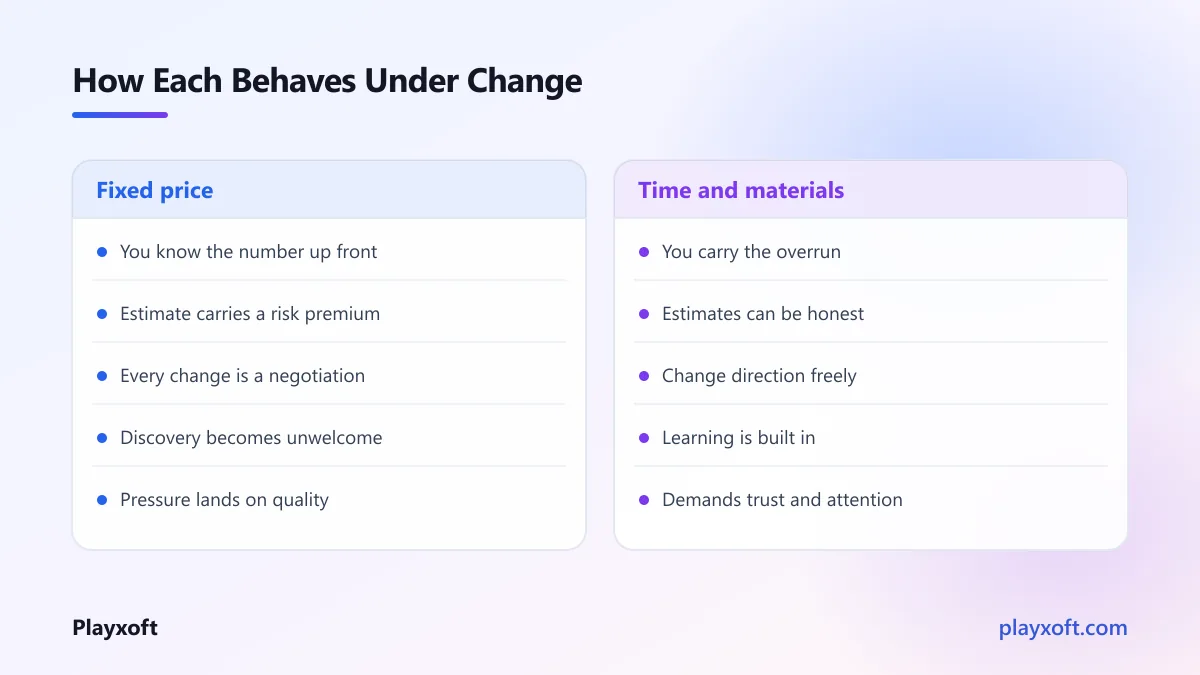
The estimate contains a risk premium. Nobody quotes their honest best case on a fixed-price deal. They quote something that survives being wrong, which means you are paying for uncertainty whether or not it materialises.
Every change becomes a negotiation. A request that would take an afternoon becomes a conversation about whether it was in scope, a change order, and an adjustment. This is not obstruction; it is the contract working exactly as designed. But it slows you down and it makes the relationship adversarial in small ways that accumulate.
Discovery becomes unwelcome. The most valuable thing that happens on a software project is learning something that changes what you should build. Under fixed price, that discovery is a problem for both parties, so there is quiet pressure to build what was specified even when both sides suspect it is no longer the best answer.
Quality is where the pressure lands. If a fixed-price project runs long, the vendor is losing money on every additional day. Something gives, and it is rarely the visible features. It is testing, documentation, and the unglamorous engineering that you do not see at handover and do pay for later.
None of this means fixed price is wrong. It means fixed price buys you certainty about the number, at the cost of flexibility and — under stress — sometimes quality.
What time and materials does to a project
The incentives invert, with their own consequences.
Changing direction is cheap. You learn something in week five and act on it in week six, with no contractual friction. For product work where the right answer is genuinely unknown at the start, this is a significant advantage.
Honest estimates become possible. With no penalty for being wrong, a vendor can tell you their realistic view rather than their defensive one. In our experience the total cost of a time-and-materials project often lands below what the same work would have been quoted at fixed price, precisely because you are not paying the risk premium.
You carry the overrun. If it takes longer, you pay for longer. That is the honest trade.
It demands trust and attention. You need confidence that hours are real and well spent, and you need to actually review progress. An unattended time-and-materials arrangement with a vendor you do not trust is the worst of all options.
Who should carry the risk
Here is the question that actually decides it: which side is better placed to control the thing that creates the risk?
If the scope is genuinely fixed and well understood — a defined integration, a migration with known endpoints, a rebuild of something that already exists — the vendor controls most of the variance, and fixed price is fair. They know how long this kind of work takes.
If the scope depends on what you learn while building — a new product, an unproven idea, anything where the requirements will change because they should — you control the variance. Asking a vendor to fix a price on that means asking them to price your indecision, and they will price it high or lock you out of changing your mind.
The uncomfortable implication: the projects buyers most want to fix-price are usually the ones least suited to it.
If you are comparing two proposals right now
A fixed-price quote and a time-and-materials quote are not directly comparable, and the arithmetic to compare them fairly is not obvious.
If you have both in hand and want help reading them side by side, we are happy to go through them with you — including working out what the fixed-price version has excluded.
The two middle options that work better
Most experienced buyers end up somewhere between the extremes. Two structures are worth knowing.
Capped time and materials. You pay for hours, but there is a ceiling. You keep flexibility and honest estimates; the vendor carries the risk above the cap. In practice this is the arrangement we see work best for product builds, because it gives the buyer a number to budget against without freezing scope.
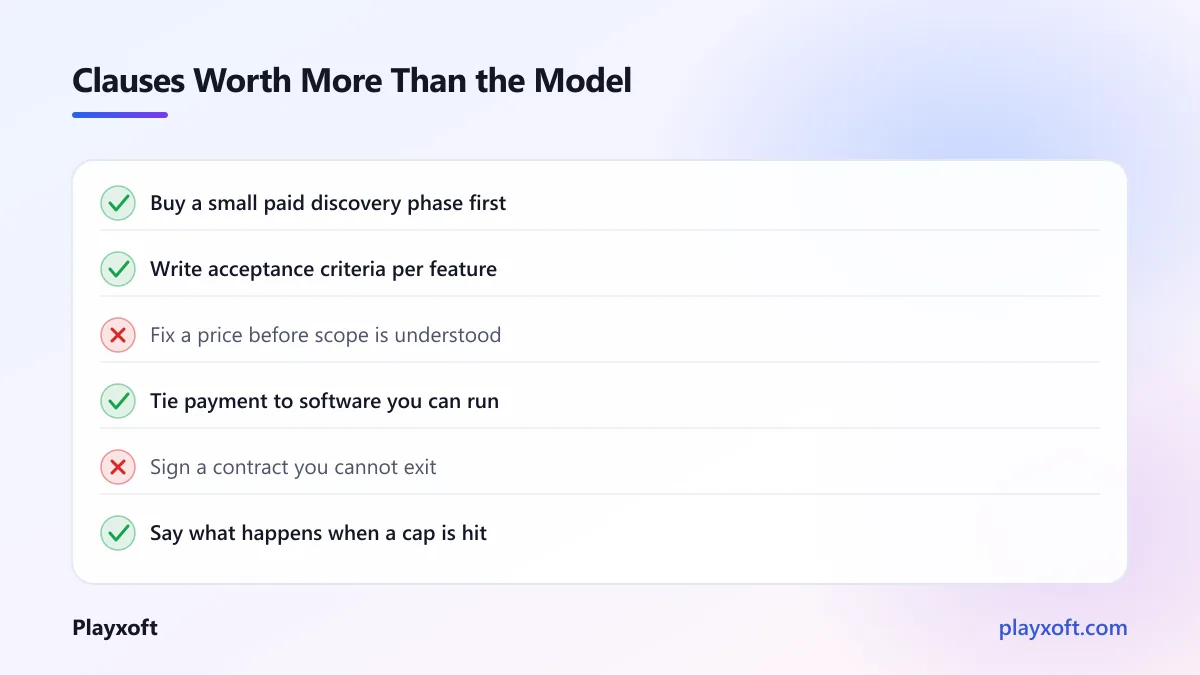
Make sure the agreement says what happens at the cap: does work stop, does scope get cut to fit, or is there a renegotiation? Unstated, that becomes an argument at the worst moment.
Phased fixed price. Break the project into stages and fix the price of each as it begins, when it is well understood. Discovery is a small fixed piece. Design is a fixed piece once discovery is done. Each build phase is fixed once the phase before it has clarified things.
This matches price certainty to the point where certainty actually exists, which is the entire problem with fixing the whole project up front. It also gives both sides natural exit points, which sounds unromantic and is genuinely valuable.
Start with a paid discovery phase either way
Whichever model you land on, the single most useful structural decision is to buy a small, separately-priced discovery phase first.
A week or two, paid, producing written scope, acceptance criteria, an architecture outline, and a properly informed estimate. For us that sits at $1,000 to $3,000 depending on complexity.
The value is threefold. You get an estimate based on understanding rather than guesswork. You find out what this team is like to work with before committing to months. And if it goes badly, you have spent a small amount to learn that, which is the cheapest possible way to learn it.
Vendors who resist a paid discovery phase are usually protecting an estimate they do not want examined.
What to put in writing regardless of model
The model matters less than these clauses, all of which are cheap to agree at the start.
- Acceptance criteria per feature, in plain language, so "done" is not a matter of opinion
- Ownership of code, designs, accounts and intellectual property, yours from day one
- A named team, with notice required before substitution
- A change process: who estimates, who approves, how the timeline adjusts
- Payment tied to milestones that correspond to something you can actually see running
- A handover definition: what you receive, in what form, and within how many days
- An exit clause either side can use with reasonable notice
The last one is worth more than people expect. A contract that is difficult to leave protects the party who wants you locked in, and that is never you. Guidance on outsourcing agreements from bodies like the ICO on data processing terms is a reasonable reference point for the data-handling clauses specifically, which are often the thinnest part of a software contract.
Reading a fixed price vs time and materials quote side by side
If you have one of each on the table, they are not comparable as written. Three adjustments make them so.
Add the exclusions back into the fixed-price number. Read what the fixed-price proposal says is not included — often testing beyond a defined period, content population, third-party costs, post-launch support, or anything discovered during the work. Price those, because you will pay for them either way.
Add your own time to both, but more to fixed price. Change orders, scope arguments and specification meetings consume your hours. A fixed-price arrangement typically demands more of your attention on contractual matters and less on the product, which is the wrong way round.
Model the time-and-materials quote at the pessimistic end. Take their range, use the top of it, then add a contingency. If that number is still acceptable, the comparison is genuinely favourable rather than optimistically so.
Done honestly, the two numbers usually converge much more than the headline figures suggest. This is consistent with what decades of software estimation research has found: the cone of uncertainty means early estimates on novel work carry a wide margin regardless of how the contract is worded. Fixing a price does not narrow that cone. It just decides who absorbs it.
The honest recommendation
For a well-defined, bounded piece of work: fixed price is fine and probably simplest.
For a new product, a first version, or anything where you expect to learn as you go: capped time and materials, or phased fixed price, preceded by a paid discovery phase.
For anything at all: the clauses above matter more than the model.
The deeper point in the fixed price vs time and materials debate is that neither contract can make a project succeed. What makes projects succeed is clear scope, an available decision-maker on your side, and working software you can see regularly. A good contract makes those easier to insist on. It cannot substitute for them.
If you are structuring an engagement and want a partner who will tell you which model actually suits your project — including when that means quoting you less work than you asked for — book a free consultation call or email info@playxoft.com.


