How Long Should It Take to Build Your App? A Realistic Timeline by Project Type

"How long will it take?" is the second question every client asks, and the one where the industry's answers are least trustworthy.
The reason is not dishonesty, mostly. It is that a development timeline is a prediction about work that has not been fully specified yet, made by people who are optimists by disposition, to someone who would prefer a smaller number. Everything about that situation pushes the estimate down.
So here are honest ranges, phase by phase, for the project types we are asked about most — along with the four things that actually cause overruns, which are almost never the things people worry about.
What every project contains, regardless of type
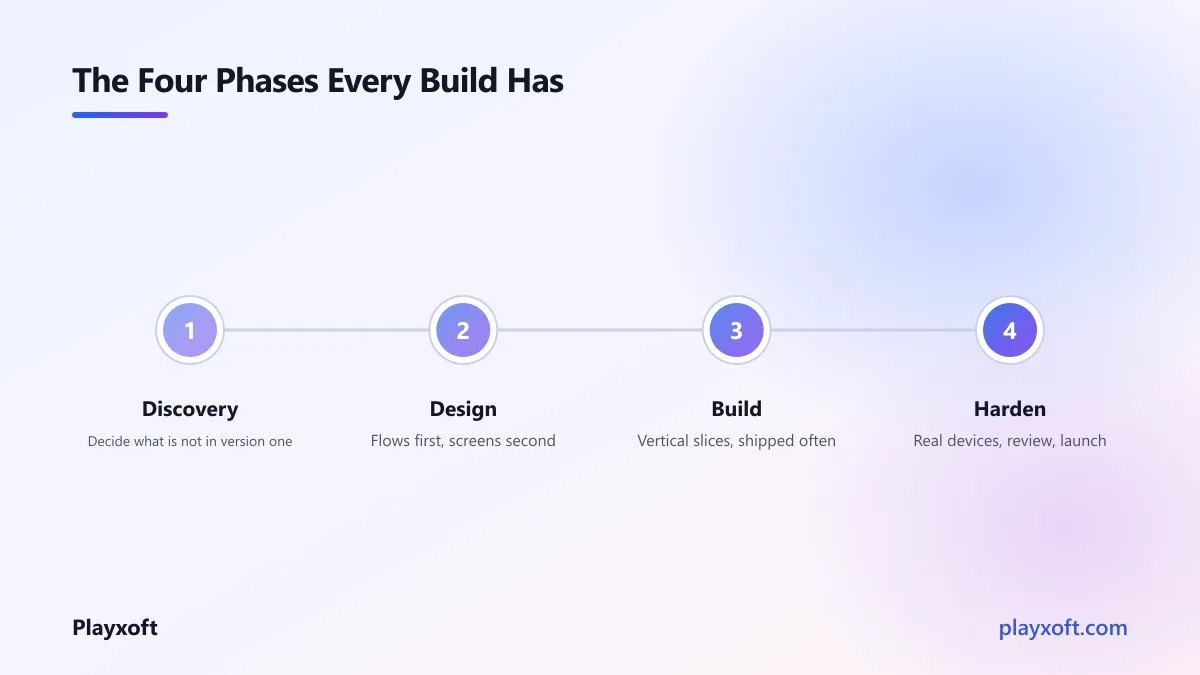
Before the type-specific ranges, four phases exist in every build. Teams that compress them do not remove the work; they relocate it to later, where it costs more.
Discovery and definition — 1 to 3 weeks. Deciding what you are building, for whom, and what is not in version one. The most valuable weeks in the project and the most frequently skipped.
Design — 2 to 5 weeks. Flows first, then screens. Running in parallel with early development once the core flows are settled.
Build — the bulk, see below. Where most of the time goes.
Hardening and launch — 2 to 4 weeks. Testing across real devices, fixing what that finds, store submission, monitoring, and the small fires of the first week. Compressing this is the most common false economy in software.
Note that these overlap. A twelve-week project is not one plus three plus six plus two in sequence.
Realistic ranges by project type
These assume a small dedicated team, a decision-maker who responds within a day or two, and a scope that stays roughly still.
A simple single-purpose mobile app: 6 to 10 weeks
A focused tool. Accounts, a handful of screens, one core function, a straightforward backend or none at all. Think a booking app for a single business, a habit tracker, a utility.
Most of the risk here is scope drift, because the small size makes additions feel harmless.
A cross-platform standard app: 10 to 16 weeks
Multiple user roles, real backend logic, third-party integrations, push notifications, payments. This is the shape of most commissioned mobile apps.
The integrations are what move this range. Two well-documented APIs add little. One poorly documented enterprise system can add a month by itself.
A SaaS platform or marketplace: 12 to 20 weeks
Multi-tenant data, subscription billing, an admin surface, permissions, notifications, and reporting. Marketplaces add the complication of two distinct user types who must both find the product useful before either does.
Billing is consistently underestimated. Subscriptions, upgrades, downgrades, failed payments, refunds and tax handling are a substantial subsystem, not a line item.
A real-time multiplayer game: 16 to 30 weeks
Netcode, matchmaking, accounts, progression, a backend that stays up under load, plus the game itself. The additional difficulty is that a game needs to be fun, which is discovered through iteration rather than specified up front.
The four things that actually blow timelines
Across projects that ran long, the cause was almost always one of these four. Note that "the developers were slow" is not among them.
1. Scope that never stopped moving
The most common by a wide margin, and it rarely arrives as a big request. It is one small addition per week, each individually reasonable, each agreed to without adjusting the date.
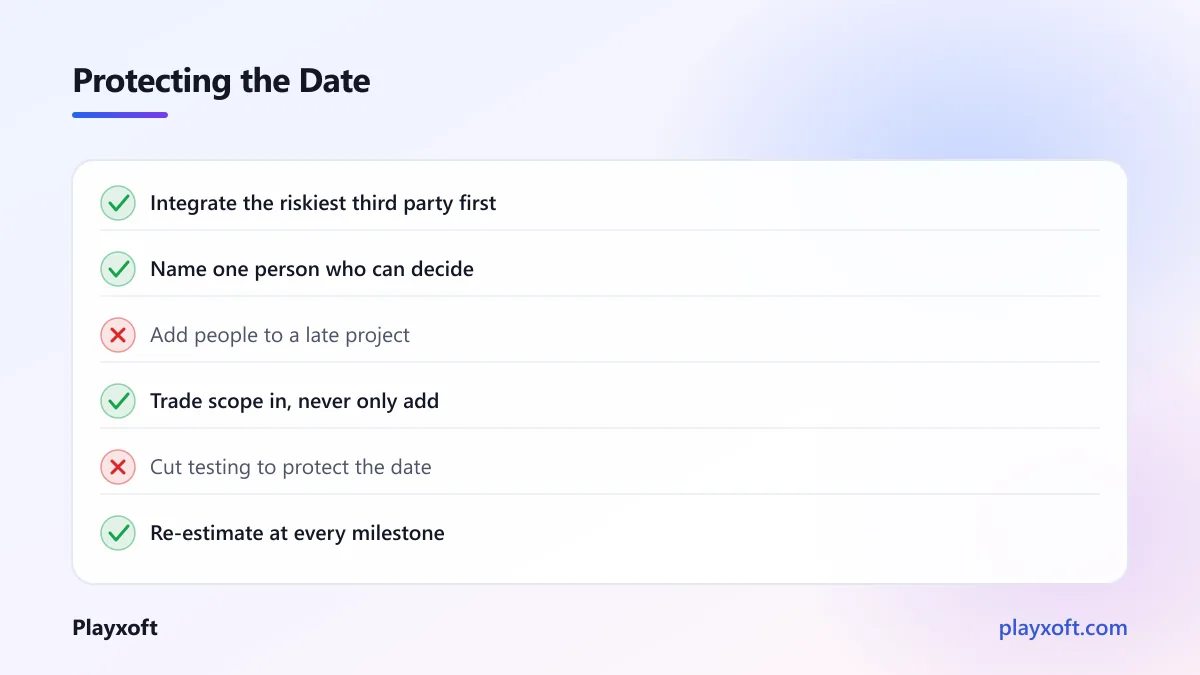
The prevention: write down the launch scope, and treat every addition as a trade. Something goes in only when something comes out, or the date moves. Keep the deferred list visible so cutting feels like sequencing rather than losing.
2. Slow feedback
A build waiting three weeks for a design review is not progressing. Worse, the team has moved on to other work, and returning to it later costs re-familiarisation.
The prevention: agree a response time before you start — two business days is reasonable — and name one person empowered to decide. A committee that meets fortnightly will add months to any project, in any model.
3. Third-party integrations
Anything depending on a system you do not control carries unbounded risk. Documentation that is wrong, sandbox environments that behave differently from production, approval processes measured in weeks, support queues that take days to answer.
The prevention: integrate the riskiest third party first, in week one, with a throwaway prototype. Finding out in week two that the API cannot do what you assumed is recoverable. Finding out in week ten is not.
4. Design changes after build started
Changing a flow after it is built means rebuilding it. Changing visual styling is cheap; changing structure is not, and the distinction is not obvious to non-designers.
The prevention: sign off flows before building, and confine later changes to appearance where possible. If a structural change is genuinely necessary, treat it as new scope with a new date.
If someone quoted you a much shorter timeline
It is worth asking what is not included, rather than assuming they are simply faster.
The usual omissions are testing, hardening, store review time, and any buffer for the unknown. A timeline without those is not a plan; it is a best case dressed as a commitment.
If you have an estimate and want a second opinion on whether it is realistic, we are happy to look at it with you — including estimates from other teams.
Why estimates are systematically optimistic
This is not specific to software, and understanding it makes you a better client.
People consistently underestimate how long their own tasks will take, even when they have overrun on identical tasks before. Psychologists call it the planning fallacy, and the striking finding is that awareness of it does not fix it. Expert estimators overrun too.
The practical defences:
Estimate in ranges, not points. "Ten to fourteen weeks" is an honest statement about uncertainty. "Twelve weeks" implies a precision nobody has.
Ask what the estimate assumes. Every estimate rests on assumptions about your availability, content, integrations and scope stability. Written assumptions are the difference between a professional estimate and a hopeful one.
Re-estimate at milestones. An estimate made before design exists is worth less than one made after. Good teams revise and explain why; teams that never revise are managing your feelings rather than the project.
How to compress a timeline honestly
Sometimes the date genuinely cannot move. Three things actually work, and several popular ones do not.
Works: cut scope. The only reliable lever. Ship the core workflow, defer the rest. A smaller product launched on time beats a complete one launched late, almost always.
Works: remove decision latency. Being available for same-day answers can meaningfully shorten a project at no cost. This is the cheapest acceleration available and it is entirely within your control.
Works: start integrations early. Front-loading the unpredictable parts converts late surprises into early ones.
Does not work: adding people mid-project. New people need onboarding from the people already productive, so the team slows before it speeds up. Fred Brooks made this point in The Mythical Man-Month half a century ago, and it has survived every change in tooling since.
Does not work: cutting testing. The bugs do not disappear. They move to after launch, where they cost more and arrive with unhappy users attached.
What an app development timeline should look like on paper
A schedule you can actually manage against has five properties. If the document you were handed lacks them, ask for a better one.
Ranges, not single dates. Each phase expressed as a span, with the widest spans on the least understood work.
Named assumptions. What the estimate takes for granted — your availability, content delivery dates, which integrations behave as documented, how stable the scope is.
Visible milestones with something to look at. Not "backend 60 percent complete" but "you can log in and create a project in a live environment." Milestones you can verify yourself are the only ones worth tracking.
An explicit buffer. Not padding hidden inside each task, but a stated contingency at the end. Hidden padding gets consumed silently; visible contingency gets managed.
A named cut list. The features that come out first if the date is at risk, agreed in advance. Deciding this calmly in week one is enormously easier than deciding it under pressure in week twelve.
We produce this as a one-page document at the start of every project, and revise it at each milestone. It is not a contract — it is a shared picture of what has to be true for the date to hold, which turns out to be the more useful artefact.
A realistic way to think about it
If you want a rough planning figure before a proper scoping conversation: most commissioned applications land between three and five months from kickoff to store or launch, with games at the longer end and single-purpose tools at the shorter one.
Anyone offering a firm app development timeline before understanding your scope is guessing, and the guess will be optimistic. Anyone offering a range with stated assumptions and a plan to revise at milestones is doing the job properly.
If you want a realistic schedule for your specific project — with the assumptions written down and the risky parts identified up front — book a free consultation call or email nitheesh@playxoft.com. We will give you a range and tell you exactly what would push it either way.


