In-House Team vs Development Agency: The Honest Cost Comparison Nobody Shows You

The board asks for a delivery plan. The product lead asks for more engineers. Finance asks for a number that will still make sense when the first release slips by a month. Someone puts two columns on a slide: a salary on one side, an agency proposal on the other. Then the conversation gets dangerously simple.
That is why the in-house team vs development agency decision so often starts in the wrong place. Neither a salary nor an invoice is the true cost of getting useful software into customers' hands. The real comparison includes the work around the work: finding people, helping them become effective, directing them, covering gaps, and surviving change.
There is no universal winner. A company building durable product capability should not outsource its judgment. A company racing to validate a new product should not pretend that hiring is instant. The useful question is not, “Which model is cheaper?” It is, “Which model gives us the right capability, at the right moment, with risk we can actually carry?”
The In-House Team vs Development Agency Cost Question Is Bigger Than Payroll
Salary is visible. It arrives in a familiar line item, which makes it feel like the whole answer. But an employee joins a system, not an empty desk. The fully loaded cost includes recruitment effort, employer contributions and benefits where applicable, hardware, software access, workspace, security processes, management time, and the time a new hire needs before they can make confident decisions.
None of those costs make hiring a mistake. They are the investment required to create a capability you own. The mistake is treating them as background noise while treating an agency invoice as the complete cost of an outside team.
An agency also has a fuller cost than its proposal suggests. There is time to choose a partner, define the work, bring the team into the product context, review decisions, and maintain a working rhythm. If the brief changes every week, a scoped engagement can become expensive through rework even when the hourly rate is reasonable.
The difference is where the uncertainty sits. With employees, the company absorbs uncertainty in capacity. You keep paying when priorities pause, a launch moves, or one specialist is temporarily underused. With an agency, the company buys a defined amount of capacity, but must be clear enough to use it well.
The hidden line items leaders should name
A serious comparison puts these questions in the open:
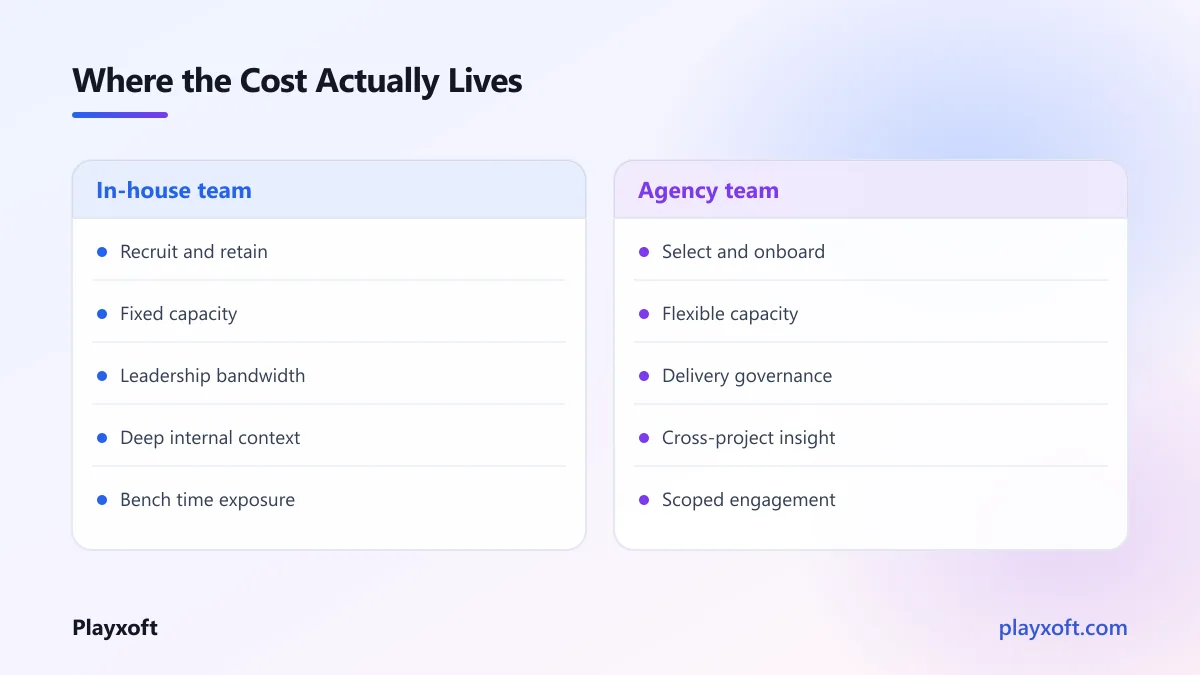
- Recruitment and retention: Who will source, interview, onboard, develop, and replace the people needed for the work?
- Ramp time: How long until a new engineer understands the product, customers, architecture, and decision history well enough to move independently?
- Management overhead: Who turns business priorities into usable product decisions, gives feedback, removes blockers, and keeps quality from becoming an afterthought?
- Equipment and access: What does secure, productive work require beyond a laptop, including tools, environments, documentation, and governance?
- Bench time: What happens to fixed internal capacity when the roadmap narrows or a project waits on a commercial decision?
- Key-person risk: If one person holds the release knowledge, customer context, or technical map, how quickly can the team recover when they leave?
The point is not to build a frightening spreadsheet. It is to make the decision honest enough that it survives the next quarter.
The Cost of an Internal Team Is Also a Strategic Investment
There are clear cases where in-house wins, and they deserve more respect than they get in outsourcing conversations.
First, choose internal ownership when software is the core of how you compete. If every customer interaction, pricing decision, or operating advantage depends on the product, the people shaping those decisions need deep and continuous proximity to the business. Context compounds. Engineers who see a customer problem recur can improve the product at its root instead of merely completing the next ticket.
Internal teams also win when the work is persistent and predictable. A stable stream of product work lets a company use fixed capacity well. It creates room for technical stewardship: paying down accumulated complexity, improving observability, mentoring newer team members, and making small improvements that never fit neatly into a project scope.
This model is especially strong where knowledge must remain close to the organisation. A regulated workflow, unusual domain rules, sensitive customer operations, or a long-lived platform can require a depth of institutional memory that is difficult to recreate at the start of every engagement. Established practices such as the NIST Secure Software Development Framework are easier to sustain when security responsibility has named, ongoing owners.
There is also a cultural benefit. A capable internal group can challenge a poor assumption before it becomes a feature request. It can push back on a deadline that would create avoidable debt. It can be present in the informal conversations where the real product strategy often appears.
But an internal team only earns these benefits when it is genuinely supported. Hiring people and then giving them a vague backlog, no product leadership, and no time to improve the system is not an in-house strategy. It is an expensive way to create frustration.
What a Development Agency Can Buy That Hiring Cannot
An agency is not just rented hands. A good one gives a company access to a working delivery system: product thinking, design, engineering, quality assurance, delivery leadership, and patterns learned across many launches. That can be far more useful than filling a single open role.
This matters when speed is tied to a decision, not simply a deadline. A startup testing whether customers will use a new workflow needs a small, focused team that can take an idea from discovery to release. A growing business with one urgent integration may need specialist experience for a concentrated period. A company rebuilding a fragile application may need fresh eyes before it commits to a permanent team shape.
The agency model can reduce bench time because capacity is engaged around a purpose. It can reduce key-person risk when the partner documents work, uses shared repositories and environments, and has more than one person able to support critical areas. It can also make a multidisciplinary team available sooner than a company can hire one role at a time.
That does not mean outside delivery is automatically lower cost. Agency rates in North America and Western Europe typically run several times higher for the same scope. Playxoft's real delivery ranges sit below typical Western agency pricing because of how our team is structured, not because we skip engineering discipline; a firm number follows a short scoping call.
The agency model fails when a client delegates accountability along with execution. A partner needs a product owner who can make decisions, timely access to users or domain experts, and a clear definition of what good looks like. No external team can manufacture that clarity from a backlog alone.
If you'd like a hand comparing your current delivery cost with the capability you actually need, talk through the decision with Playxoft. A short conversation can reveal whether the gap is people, product clarity, or delivery structure.
The Risks That Distort Both Choices
The most expensive outcome is not choosing the wrong label. It is creating a setup where nobody owns the whole result.
For an internal team, watch for a single senior engineer becoming the route through every important decision. That person may be brilliant, but the organisation becomes fragile if knowledge is not shared. Teams need documented decisions, peer review, and enough overlap that absence does not stop delivery. The Google Site Reliability Engineering handbook is a useful reminder that reliable systems come from repeatable practices, not heroic individuals.
For an agency, watch for a relationship built around output instead of outcomes. A weekly list of completed tasks can look healthy while the product drifts from the customer problem. The remedy is not more status meetings. It is a shared product goal, visible decision owners, regular demonstrations, and honest conversations about trade-offs.
Both models can create debt when the team is rewarded only for visible feature work. Delivery health needs a wider view: release confidence, support burden, learning from users, and the ability to change direction. The DORA research programme is valuable here because it treats software delivery as an organisational capability rather than a contest of individual effort.
Why a Hybrid Model Is Usually the Practical Answer
For most businesses, the answer is neither a permanent internal team for every task nor a fully detached agency relationship. It is a deliberate hybrid model.
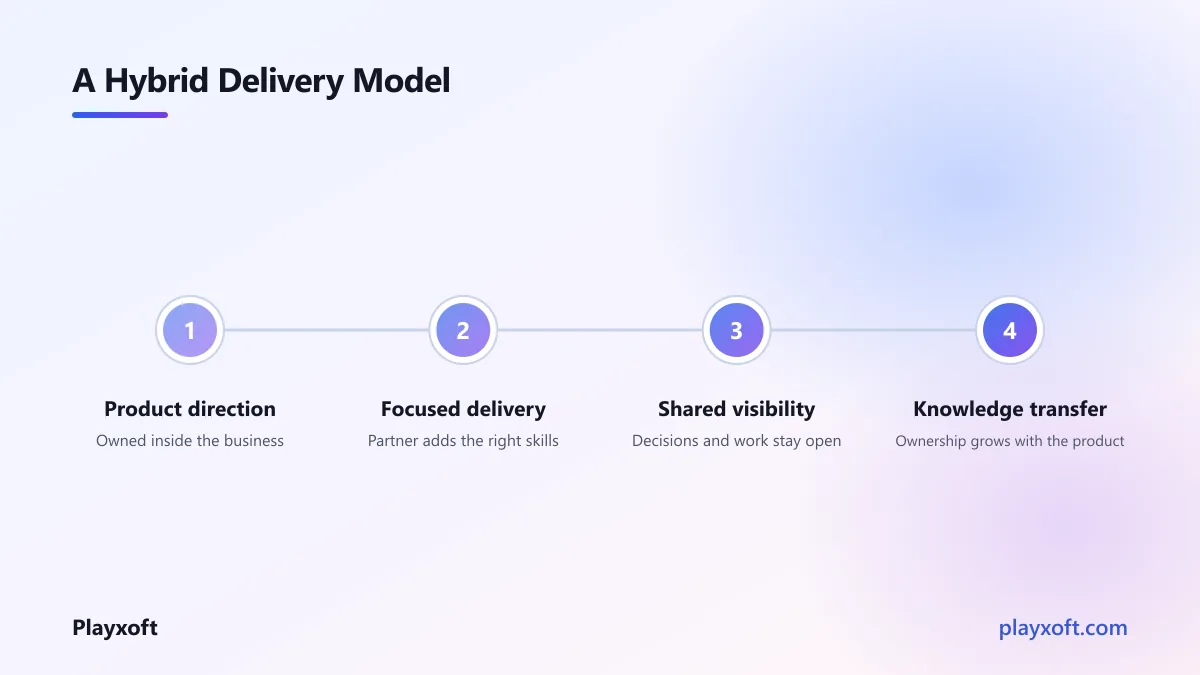
Keep product direction, customer knowledge, commercial priorities, and core technical judgment close to the business. Those are the muscles that determine whether software creates value. Then use an agency to add momentum where the internal team has a temporary gap: discovery, product design, a mobile build, a difficult integration, a release push, or a specialist capability that would be wasteful to hire before demand is proven.
The strongest hybrid arrangements make boundaries explicit. The internal side owns the problem, priorities, approvals, and long-term product story. The agency owns an agreed delivery outcome, transparent working practices, documentation, and a handover that leaves the client stronger. Architecture, code, environments, and decisions should remain visible to both sides from the beginning.
This is not a compromise born of indecision. It is capacity design. It lets a company keep the knowledge that compounds while changing the capacity that does not need to be permanent. It also gives leaders a better way to learn: use a focused engagement to discover the true shape of the work, then hire with evidence instead of optimism.
Make the hybrid model work in practice
Before you begin, agree on a few operating rules:
- Name one internal product decision-maker with authority to resolve trade-offs quickly.
- Define what knowledge must stay inside, including customer insight, architecture decisions, and operational access.
- Give the agency direct access to the people and evidence required to understand the problem.
- Set a rhythm for demonstrations, decisions, and risk reviews rather than relying on a monthly summary.
- Treat documentation and handover as delivery work, not an optional final-week activity.
- Reassess the team shape when the product moves from exploration to repeatable operation.
The exact split will change. Early on, an outside team may carry most of the build. Later, internal engineers may take ownership of a stable product while a specialist partner supports new bets. That movement is healthy when it follows the product's needs instead of an old org chart.
Make the In-House Team vs Development Agency Choice a Capability Decision
The best leaders stop asking which option has the smaller headline cost. They ask what capability the business needs to own, what uncertainty it can absorb, and what needs to happen before the opportunity passes.
Choose in-house when enduring product context, steady demand, and strategic control justify building a lasting capability. Choose an agency when you need a focused, cross-functional team, specialist depth, or faster access to delivery capacity. Choose a hybrid model when the sensible answer is to own the judgment and flex the execution.
The in-house team vs development agency decision is ultimately about creating enough confidence to move without creating a cost structure you cannot sustain. If you want to turn that decision into a clear delivery plan, book a free consultation call with Playxoft or write to info@playxoft.com. We will help you shape a team model that gets the product moving and keeps you in control of what matters.


