The Backend Every Multiplayer Game Needs - And What It Costs to Run

The prototype works. Two phones on the same office network, two players, movement syncing, everyone in the room genuinely excited. It took a fortnight.
Then someone asks what happens when there are five hundred players in eleven countries, half of them on patchy mobile data, and one of them has decided to cheat.
That gap — between a working prototype and something that survives real players — is the multiplayer game backend. It is the least visible part of the game and a large share of the engineering. Here is what it actually consists of, why each piece exists, and what it costs once players arrive.
The authoritative game server
The first architectural decision, and the one everything else follows from: who decides what is true?
In a peer-to-peer setup, players' devices agree among themselves. It is cheap because you run no servers. It is also trivially cheatable — a modified client can simply claim it scored, and the others have no way to disagree.
In an authoritative setup, a server you control runs the actual game simulation. Clients send inputs, the server decides outcomes, and clients display what the server says. Cheating becomes much harder because the cheater's device does not get a vote.
For anything with competition, ranking, or money involved, authoritative is the only serious choice. The cost is that you now run game servers, and game servers are the most expensive part of what follows.
One nuance worth knowing: authoritative does not mean players wait for the server. Good netcode predicts locally and reconciles when the server disagrees, so movement feels instant while remaining verifiable. Getting that reconciliation right is much of the craft in multiplayer engineering — Valve's write-up on source multiplayer networking remains one of the clearest explanations of how prediction, interpolation and lag compensation fit together.
Matchmaking
Putting players together sounds simple and is the source of an unreasonable number of problems.
A matchmaker balances things that pull against each other: skill similarity, connection quality, wait time, and party size. Tighten skill matching and wait times grow. Loosen it and matches feel unfair. Prioritise low latency and you fragment your player pool by region.
The hardest period is the beginning, when you have few players. A matchmaker tuned for a healthy population will leave your first hundred users waiting in empty queues, which is the fastest way to lose them. Early on, you generally want aggressive relaxation of criteria over time, and often bots to fill gaps.
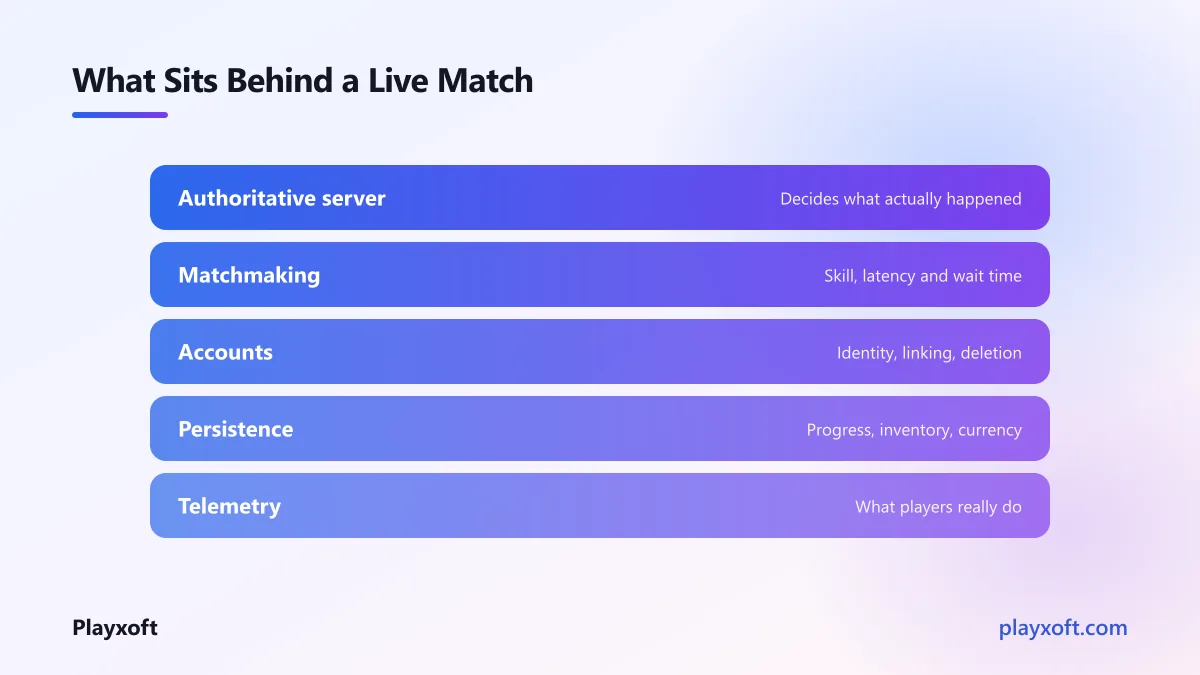
Accounts and identity
Players need to be recognisable across sessions and devices. That means storing an identity, linking it to platform sign-in, and handling the awkward cases: a player who started as a guest and now wants to keep their progress, a player with the same account on two devices, a player who wants their data deleted.
The last one is not optional. Data protection rules in most markets give players a right to deletion — the right to erasure under European data protection law is the widely-copied template — and retrofitting that into a system that scattered player data across six tables is genuinely painful. Design for it at the start.
Persistence: progress, inventory, currency
Anything the player earns has to survive, and it has to survive correctly.
This is where multiplayer backends get quietly serious. If your game has currency or items, you have built a small financial system, with all the correctness requirements that implies. Two devices claiming the same reward, a purchase that succeeds on the store but fails to credit, a duplication bug during a disconnect — each of these is a support nightmare and a potential economy collapse.
The practical requirements: transactional writes so a change either fully happens or does not, idempotent operations so a retried request does not double-credit, and an audit trail so you can reconstruct what happened when a player disputes it.
Leaderboards, friends and chat
These three get treated as features and are really infrastructure.
Leaderboards are harder than they look at scale, because sorting millions of scores and finding one player's rank is expensive if done naively. They also attract cheaters more than anything else in the game, which loops back to the authoritative server decision.
Friends and social graphs need invites, requests, blocking, and presence. Presence — knowing who is online right now — is deceptively costly, because it changes constantly and everyone wants to see it live.
Chat carries obligations beyond the technical. You need moderation, reporting, and blocking, particularly if minors can play. Shipping unmoderated chat in a game with a young audience is a reputational and regulatory risk that a lot of teams discover late.
If this list is longer than you budgeted for
That reaction is normal, and it is the single most common reason multiplayer projects overrun. The game is the visible part; this is most of the work.
It is also work that has been done many times, which means it does not need rebuilding from nothing. We maintain backend components for exactly these pieces — we are happy to talk through what your game would actually need, including the parts you can safely leave until later.
Telemetry, or you are flying blind
Once the game is live, you need to know what players do. Not opinions — behaviour.
At minimum: session length, where players stop playing in their first session, match completion rates, the point in progression where people give up, and what paying players did differently. Without this, live operations is guesswork, and live operations is where a multiplayer game makes its money.
Instrument before launch. Retrofitting analytics after a difficult launch means the crucial first weeks of data are simply gone.
What it costs to run
The honest answer is that it depends on concurrency, not downloads. A million installs with a hundred people playing at once costs far less than fifty thousand installs with two thousand concurrent.
For a live multiplayer game backend, hosting typically starts around $200 to $900 per month and scales with concurrent players. The main drivers:
Game server hours. The biggest line item for real-time games. You are paying for machines that can run simulations, and they must be available in each region you serve. Scaling these down during quiet hours matters enormously.
Regional presence. Latency is geography. Serving players in three continents means infrastructure in three continents, which roughly multiplies your baseline rather than adding to it.
Data transfer. Frequent state updates to many clients adds up, and egress is often priced less favourably than compute.
Database operations. Usually modest unless your design writes to persistent storage on every action, which is a common and expensive mistake.
For context on building the game itself, our own ranges run $15,000 to $30,000 for a simple real-time multiplayer mobile game and $30,000 to $70,000 for a mid-scale title with live operations — meaningfully below typical North American and Western European studio pricing, because of how our team is structured rather than because of shortcuts.
What you can defer, and what you cannot
Not everything needs to exist at launch. From experience, the split is roughly:
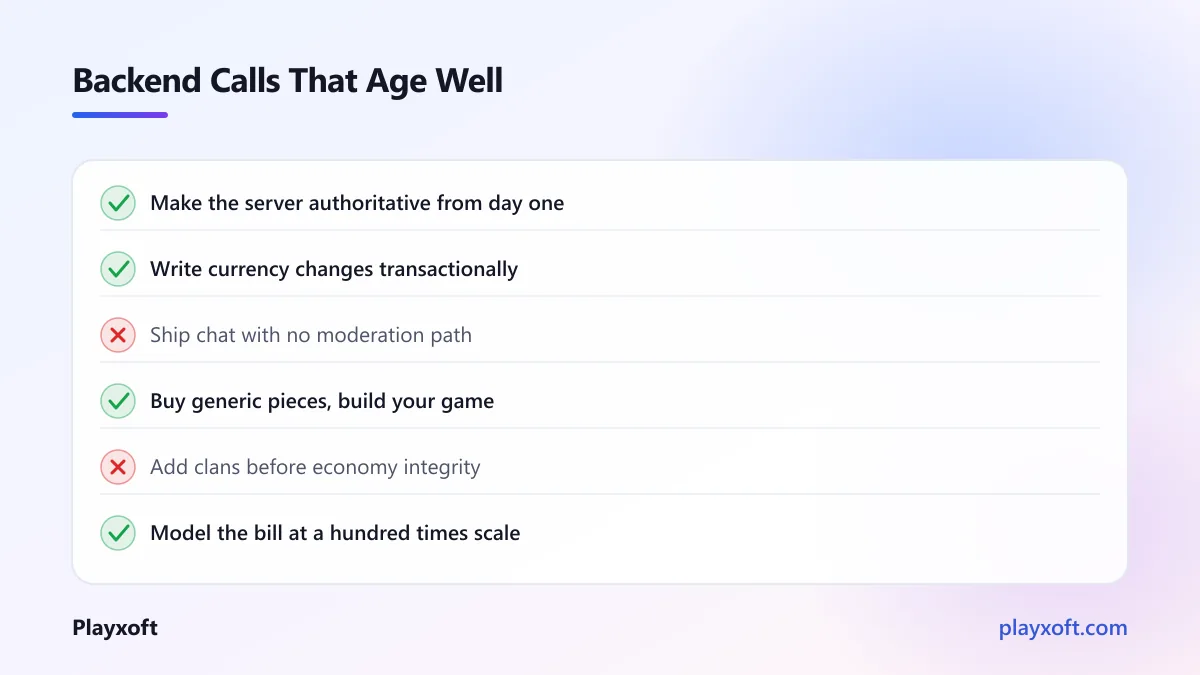
Cannot be deferred: authoritative server if the game is competitive, accounts, transactional persistence for anything earned or bought, basic telemetry, and moderation if chat exists.
Can usually wait: sophisticated skill-based matchmaking, cross-platform play, guilds and clans, replays and spectating, and elaborate seasonal systems.
The mistake we see most often is inverting this: teams build clan systems and cosmetic economies before they have transactional integrity on the currency those cosmetics cost.
Build or buy?
Several platforms provide matchmaking, leaderboards and accounts as managed services. Using them is often the right call, particularly early.
Buy when the piece is generic — accounts, leaderboards, chat, analytics. There is no competitive advantage in your version of a friends list, and maintaining one costs you forever.
Build when the piece is your game — the simulation itself, anything where your specific rules determine correctness, and anything where a vendor's pricing at scale would become untenable.
The trap is picking a managed service without checking its pricing at success. Many are generous at small scale and expensive at the scale you are hoping for. Model the bill at a hundred times your current players before committing.
The backend is where multiplayer games are actually won
Players will never praise your matchmaking. They will absolutely quit over a lost purchase, a rubber-banding match, or a queue that never fills.
A multiplayer game backend is infrastructure in the truest sense: invisible when it works, and the entire experience when it does not. Budgeting for it properly at the start is the difference between a game that grows and one that gets great reviews for two weeks and then empties out.
If you are planning a multiplayer title and want a realistic picture of the backend work, the running costs, and what you can safely leave for version two, book a free consultation call or email info@playxoft.com. We build these, and we will tell you plainly which parts your game actually needs.



