How Much Does It Cost to Build a Multiplayer Mobile Game in 2026?

A multiplayer mobile game can look deceptively small on a pitch deck: a familiar game loop, a few polished arenas, a social layer, and a launch on the major stores. Then the first real playtest starts. One player has a weak connection, another leaves a match midway through, and a third finds a timing edge that only appears when two devices disagree about the game state. The feature list did not change, but the work did.
That is why multiplayer game development cost is not just the cost of building a game twice. It is the cost of making one shared experience feel fair, responsive, and available to people using different devices and networks. Art, gameplay, netcode, backend services, live operations, and store compliance all have to arrive together.
Playxoft has seen this pattern from the studio side. The least expensive-looking multiplayer decision can become the most expensive part of a release when it is postponed: authority rules, match recovery, player reporting, version compatibility, or a server bill that nobody owned after launch. A useful estimate starts by exposing those decisions early.
Why multiplayer costs more than a single-player build
A single-player mobile game still needs strong controls, art direction, performance work, device testing, progression, and store preparation. Its game state can usually live on the player's device. When an update goes wrong, the scope is serious, but it is often contained.
Multiplayer changes the boundary. The game now has to decide whose version of an action is trusted, how players are grouped, what happens during a dropped connection, and whether an update can coexist with a previous client version. Those are product decisions as much as engineering decisions.
In practical terms, every core action has at least two jobs:
- It must feel immediate on the local device.
- It must be validated and reflected consistently for the other players.
That second job reaches into nearly every discipline. A character ability needs animation and effects, but it also needs timing rules, data shared by every participant, testing under delay, and protection against invalid inputs. A cosmetic reward needs art and an interface, but it may also need inventory storage, receipts, entitlements, and customer-support recovery.
The Unity Netcode for GameObjects documentation is useful reading here because it makes the separation visible: network objects, ownership, state synchronization, and remote procedure calls are not a switch added at the end of gameplay. They are part of how the game is designed.
The scope bands that make sense
For a simple real-time multiplayer mobile game, Playxoft's estimate is $15,000 to $30,000. This is the range for a deliberately narrow loop: limited modes, a small content set, and a focused technical foundation.
A mid-scale multiplayer game with live operations is typically $30,000 to $70,000. That scope can support more content, structured progression, operational tooling, and a launch plan that expects the team to learn from players after release.
An ambitious multiplayer title is $70,000 to $140,000. The difference is not a shinier menu. It comes from the accumulated demands of deeper game systems, richer content, broader device coverage, resilient services, and a longer operational runway.
These are Playxoft's actual delivery ranges. They sit below typical North American and Western European agency pricing because the team is structured efficiently, not because it skips engineering discipline; a firm number follows a short scoping call.
What drives multiplayer game development cost
The strongest early estimate separates the work into systems that can be discussed, prototyped, and tested. A single all-in number hides the choices that change it.
Gameplay and game design
Gameplay is where a multiplayer project earns its technical complexity. The team needs to define the match loop, controls, pacing, win conditions, progression, and social moments. It also needs to identify which actions are predicted locally and which require a server decision.
Fast action games often demand more care around timing, hit validation, and state reconciliation. Turn-based games may need less intense synchronization, yet still require strong reconnect, timeout, and anti-abuse rules. A studio that chooses the interaction model before choosing the networking stack avoids paying to reverse a design that was never network-friendly.
Playxoft normally treats the earliest playable slice as a decision tool, not a marketing demo. It should include the riskiest player action, a real connection path, and enough instrumentation to show where play breaks. That gives the client a clear answer about whether the proposed fun survives real network conditions.
Art, interface, and content production
Multiplayer art is more than character models and backgrounds. Players need readable status changes, clear ownership cues, match feedback, emotes or social signals when they fit the game, and visual language that works on small screens. A dramatic effect that hides an opponent's action may look good in a recording and feel unfair in a live match.
Content also has to work as a service. Designers and artists benefit from data-driven definitions for items, levels, rewards, and balance values. That makes a later adjustment less dependent on a full client update. It does not remove review and testing, but it keeps ordinary tuning from becoming a code release.
Netcode and session authority
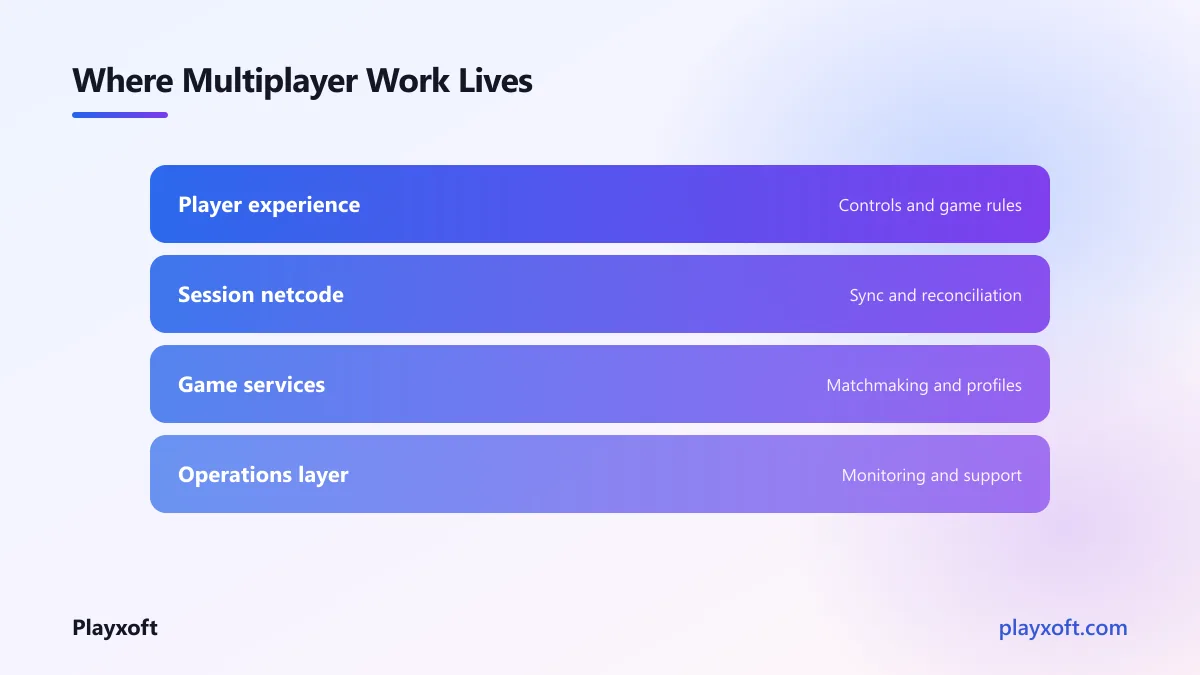
Netcode is the engineering layer that makes a shared match believable. It handles connection flow, state updates, lag behavior, ownership, and the rules for resolving disagreement. It is also where a project can quietly overspend when the team starts with technology rather than a clear authority model.
For many competitive games, the server should be authoritative over the meaningful state. The client can predict movement or display immediate feedback, while the server validates outcomes. That approach takes careful engineering, but it reduces the temptation to trust a modified client with decisions that affect ranking, currency, or match results.
The correct architecture depends on the game. Peer-to-peer, relay-assisted, dedicated-server, and managed session approaches each place different limits on cost, operations, cheat resistance, and player experience. The Amazon GameLift Servers overview illustrates the operational concerns around session placement and scalable hosting; it should inform an architecture discussion, not replace one.
Backend services and player trust
The backend carries work that players rarely notice until it fails: identity, profiles, inventory, matchmaking inputs, leaderboards, notifications, analytics events, remote configuration, and support recovery. A lean first release may combine some of these carefully, but it should not pretend they are free.
Player trust belongs in this budget too. A multiplayer game may need report flows, moderation review paths, rate limits, fraud checks around purchases, and rules for bans or appeals. The precise set depends on audience and features, but the decision must be made before social systems go live. Retrofitting it after a harmful incident is a poor way to discover the requirement.
Where studios commonly overspend
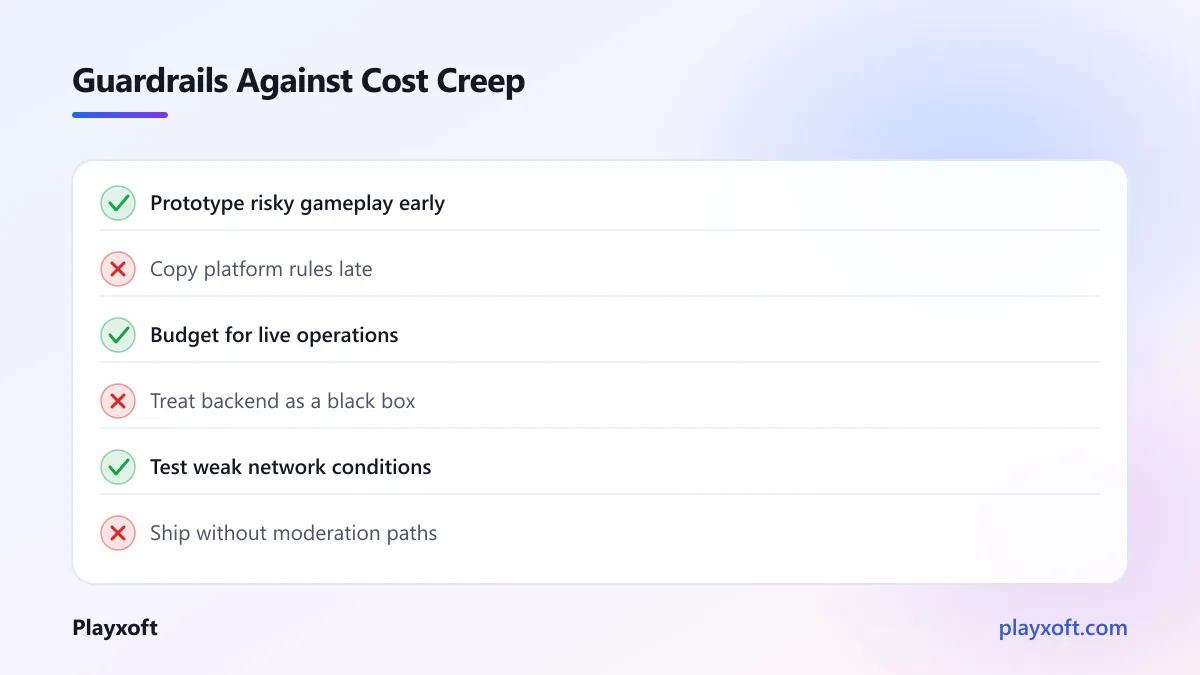
The recurring problem is not that teams care too much about quality. It is that they buy polish before resolving risk. In a multiplayer game, risk lives at the boundaries between the client, server, player, and store.
Building content before proving a match
It is easy to commission many environments, character skins, or level variants before the first match is stable. If the loop needs to change, that content becomes expensive evidence of a decision made too soon. A better sequence proves the core match with representative art, then expands only when the networked experience is worth scaling.
Choosing features without operational owners
Chat, clans, ranked ladders, user-generated names, and competitive rewards all create ongoing work. Someone needs to read alerts, investigate reports, tune thresholds, answer support requests, and make the call when a bad release needs to be rolled back. If that person is unnamed, the work has not disappeared; it has merely been deferred.
Treating the backend as invisible
Some teams price the client, add a generic backend line, and assume the rest will be managed. But matchmaking logic, player data, dashboard access, event pipelines, and release controls are product features. They deserve acceptance criteria, test cases, and a clear owner.
If a studio would like a hand turning its game concept into a scoped technical plan, talk with the Playxoft team about the first playable slice, authority model, and live-service responsibilities.
The reality of servers after launch
Launching is the handoff from build work to operating a game people can rely on. The live multiplayer backend typically starts around $200 to $900 per month and rises with concurrent players. That is an infrastructure range, not the complete cost of operating the product.
The team also needs an operating rhythm: monitor match failures and crashes, watch service capacity, review purchases and player reports, respond to store feedback, and plan patches with safe rollback options. Support and maintenance retainers range from $500 to $2,500 per month, depending on what the studio asks the delivery team to own.
Server spending is not simply a hosting question. It follows design. More simultaneous matches, more frequent state updates, larger payloads, detailed telemetry, and high-availability expectations all create ongoing demand. A cost-conscious team measures what matters, sets sensible retention rules, and keeps a path to adjust capacity as real player behavior emerges.
Live operations also means changing the game without breaking its community. A balance update should be observable. A content release should have a rollback plan. A new client version should be compatible with the service state it expects. The operational toolset does not need to be elaborate on day one, but it must let the team see and act on the signals that protect players.
Store compliance belongs in the plan
Store submission is not a final administrative task. Mobile platforms review the actual player journey: account creation, purchases, subscriptions where relevant, privacy disclosures, age suitability, support routes, and the content players can share with one another.
Apple's App Review Guidelines and the Google Play Developer Policy Center should be part of planning, especially for multiplayer features that introduce accounts, communication, purchases, or user content. The team should translate relevant policy requirements into product stories early, then test them like any other release requirement.
That changes the delivery plan in useful ways. A reviewer needs a clear route into the game. A support contact cannot be an afterthought. Account deletion and data handling need product and backend treatment. If an experience includes player communication, the reporting and blocking journeys must be coherent before launch, not improvised under review pressure.
A practical way to scope the first release
Before asking for a final estimate, a game team should be able to answer a short set of questions:
- What is the smallest match that proves the game is fun with real players?
- Which outcomes must the server validate to preserve fairness?
- What happens when a player disconnects, reconnects, or uses an older client?
- Which live signals will tell the team a match, purchase, or release is failing?
- Which social, support, and compliance flows must be ready on launch day?
The result is not a list of vague features. It is a build sequence: prototype the risky loop, validate the multiplayer behavior, prepare services and store paths, then add content and operational capacity with evidence. That sequence is what keeps a budget tied to decisions rather than hope.
Build the multiplayer game players can trust
Multiplayer game development cost becomes manageable when the team scopes the shared experience, not just the visible client. The right first release protects the core match, gives the studio enough operational control to learn, and leaves room to grow without tearing out its foundation.
Playxoft can help turn that plan into a shippable mobile game with clear technical trade-offs and a realistic path through launch. Book a free consultation call, or send the concept to info@playxoft.com, and the team can map the build, server, and live-operation work before cost surprises take over.


