The MVP Feature Cut List: How to Decide What Not to Build First

Most MVPs do not fail because the team built too little. They fail because the team built too much of the wrong thing before learning whether a customer would return for the central promise.
That is why MVP feature prioritization is not a backlog-cleanup exercise. It is a leadership decision. Every feature you keep tells the market what you believe the product is for. Every feature you cut creates space to test that belief sooner.
The hard part is that cutting scope can feel irresponsible. Founders worry that a product with rough edges will look unfinished. Product teams worry that a missing feature will create support work. Engineers worry that a shortcut will become permanent. All fair concerns. But a crowded first release has its own cost: it hides the signal you need and makes every next decision slower.
The answer is not to strip a product until it is barely usable. It is to protect the smallest complete experience that lets a real person get a meaningful result. Everything else has to earn its place.
The thesis: your MVP is a learning machine
An MVP should not be defined by how few screens it contains. It should be defined by how quickly it can answer the most expensive unanswered question in the business.
For a marketplace, that question may be whether buyers trust the supply enough to make a request. For an operations tool, it may be whether a manager will replace a spreadsheet with the new workflow. For a creator product, it may be whether someone finishes and shares the thing they started.
This is close to the logic behind the build-measure-learn cycle popularised by Lean Startup thinking. Build only enough to run a useful experiment, measure behaviour rather than compliments, then learn what deserves the next investment.
The implication is easy to miss: a feature is not valuable because it sounds useful in isolation. It is valuable if it helps the customer complete the defining job, reduces a critical uncertainty, or makes that completion trustworthy.
That is a much stricter test than asking whether a feature belongs on the eventual roadmap. Plenty of things belong on the eventual roadmap. Very few belong in version one.
Start with the one core loop
Before you rank features, write one sentence that describes the repeated customer action your product exists to enable:
A specific user comes to the product, does a specific action, receives a specific outcome, and has a reason to come back.
For example: “An independent consultant uploads meeting notes, receives a useful project summary, and sends it to a client.” Not “users manage projects.” The second statement is a category. The first is a loop.
Then map the loop in plain language:
- What brings the person in?
- What must they provide or choose?
- What processing or decision happens?
- What outcome proves the product helped?
- What makes a second use likely?
If a proposed feature does not help one of those moments, it begins in the cut column. It can earn its way back later, but it should not start with the benefit of the doubt.
This is also where teams discover that they have been treating implementation detail as customer value. A notification system, a configurable dashboard, a team permission model, and a reporting area may all be sensible. Yet none automatically improves the first successful pass through the loop.
The core loop gives you a better conversation. Instead of debating whether advanced filters are “important,” ask: would a new customer fail to reach the promised result without them? If the answer is no, the feature is probably a later decision.
MVP feature prioritization is a decision, not an inventory
Teams often make a feature list and label items must-have, should-have, or nice-to-have. That is better than no sorting, but it leaves room for every stakeholder to call their preference a must-have.
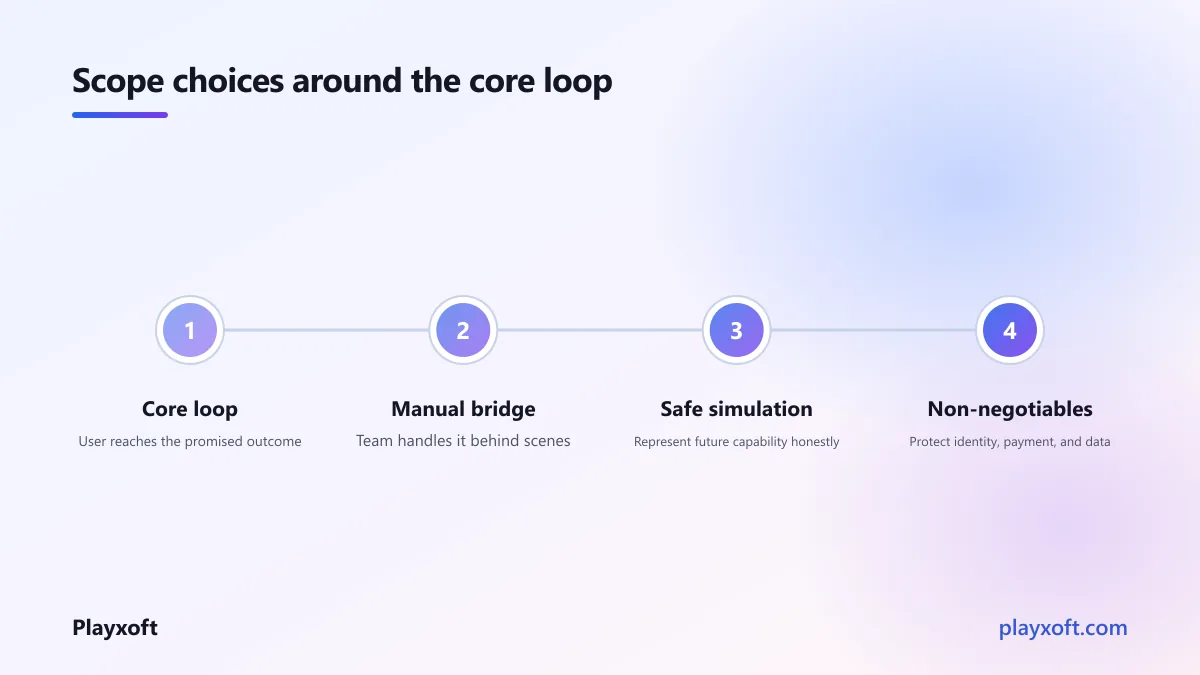
A stronger approach is to put every item into one of four operating choices: build now, handle manually, simulate honestly, or defer. Those choices turn abstract scope debates into practical decisions about what users will actually experience.
Build it now when it completes the promise
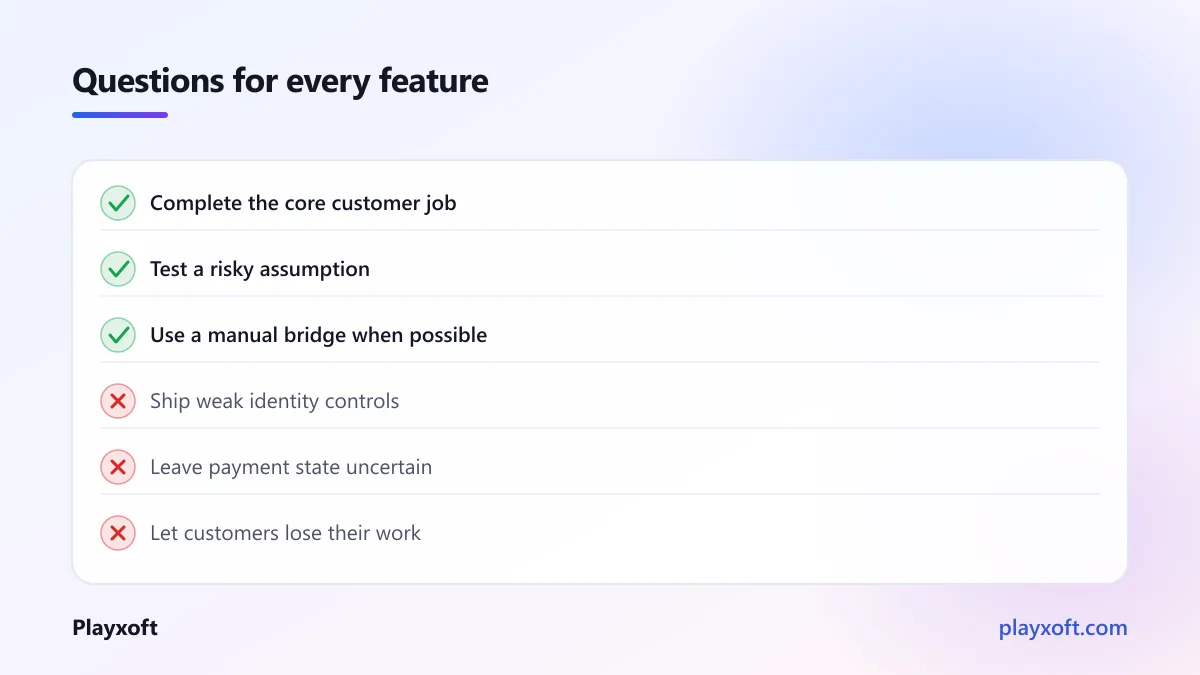
Build a feature for the first release when removing it breaks the core loop, makes the main outcome unreliable, or creates unacceptable harm. The product needs enough real capability for a customer to judge the promise fairly.
For a scheduling product, availability and booking confirmation may be real features. For a document workflow, saving, retrieval, and clear status may be real features. The exact interface can remain simple, but the job cannot be pretend.
Make it manual when people can bridge the gap
Many early capabilities do not need automation; they need an accountable process. A founder or operations teammate can review a submission, configure an account, approve a match, correct imported data, or send a tailored update.
Manual work is not a failure of product thinking. It is a way to learn what automation should eventually do. The condition is that the manual step must be visible to the team, repeatable for a short period, and respectful of the customer’s time. If it requires hidden chaos every day, it is not a bridge; it is an unpriced feature.
Simulate it only when the promise remains honest
Some things can be represented before the full system exists. A preview may use a constrained template. An integration may start with a supported file import. A recommendation may be curated by a domain expert. A dashboard may show a deliberately small set of signals.
The line is trust. Do not imply that an automated decision is live when a person made it. Do not present a future capability as current. Nielsen Norman Group’s guidance on prototype fidelity is useful here: the right level of fidelity depends on what you need people to evaluate. A limited implementation can be valid; a misleading one damages the learning you hoped to gain.
Defer it when it solves a future problem
Defer features designed for scale before you have repeatable demand: complex roles, endless configuration, broad integrations, sophisticated analytics, localisation variants, and workflow branches for edge cases you have not seen. They may be necessary later. At the start, they often make the product harder to explain and the code harder to change.
If you would like a hand turning a crowded roadmap into a testable first release, talk with Playxoft about your MVP. A short product conversation can expose where a manual process or narrow first workflow will create faster learning.
What cannot ship broken
Scope discipline is not permission to be careless. There are areas where an MVP can be visually plain but cannot be unreliable. A useful rule: if a failure compromises identity, money, or a customer’s work, do not treat it as an experiment.
Authentication and access
Authentication can be minimal, but it must reliably identify the right person and protect their account. Use proven identity patterns and review the basics in the OWASP Authentication Cheat Sheet. Do not invent a weak sign-in flow merely to save a sprint.
Also think beyond login. If different customers should not see one another’s data, access boundaries are core product behaviour, not polish. A simple role model is often enough early on. It still needs to work every time.
Billing and payment state
You can defer pricing experiments, invoices, promotions, and a beautiful account portal. You cannot let someone pay and then leave them unsure whether the product recognised it. Payment success, failure, retry, and cancellation states must be clear and reconciled.
This is not a reason to build a payment platform. It is a reason to use a trusted provider and implement the relevant events carefully. The customer should never need to guess whether they have access after money changes hands.
Data loss and destructive actions
Early users are often generous with their patience, but they do not forget lost work. Persist the information that makes the core loop valuable. Make destructive actions deliberate. Give people recovery where the risk is meaningful. Test the unhappy path, not only the happy demo.
The same standard applies to privacy promises. Collect less data when you can, explain what you collect, and avoid building a feature that relies on data handling you cannot support responsibly.
A copyable scoring rubric for the cut list
Here is a simple rubric that works in a workshop, a product review, or a founder’s notebook. Give each candidate feature a score from zero to three on each question. The score is not a substitute for judgment; it makes the judgment visible.
Core-loop contribution
- Zero: the feature does not affect the first successful outcome.
- One: it makes the outcome nicer or faster.
- Two: it removes a common obstacle in the workflow.
- Three: without it, the customer cannot complete the promised job.
Learning value
- Zero: it does not test an important assumption.
- One: it offers general feedback.
- Two: it reveals a meaningful customer preference.
- Three: it tests the central business or behaviour assumption.
Trust and risk
- Zero: failure would be inconvenient but recoverable.
- One: failure would create support work.
- Two: failure would undermine confidence in the result.
- Three: failure could expose identity, payment, or customer data.
Replaceability for now
Score this one in reverse. A three means a person, a simple workflow, or an honest simulation can cover the need for now. A zero means there is no credible substitute.
Add the first three scores, then subtract replaceability. High scores are candidates to build now. Middle scores invite a manual or simulated path. Low scores move to a named later milestone, not a vague “someday” pile.
One warning: do not let a high engineering effort score rescue a weak feature. Difficulty is not evidence of value. If a feature is hard and scores poorly on the customer questions, cutting it is usually the clearest decision you can make.
Run the cut-list meeting like a product decision
The process matters as much as the rubric. Put the proposed features in front of the people who understand customers, delivery, and risk. Ask each owner to state which part of the core loop the feature serves. Ask what would happen if a human handled it for the first set of customers. Ask what specific evidence would bring it back.
Then make cuts visible. A cut list is not a graveyard. It is a sequence plan. For every deferred item, record the trigger that would justify reconsidering it: repeated customer requests, a manual task becoming a bottleneck, a conversion problem, or a clear revenue opportunity.
This protects the team from reopening the same argument every week. It also shows stakeholders that “not now” is an intentional answer, not neglect.
In the projects we have shipped, the strongest early products tend to make one promise with unusual clarity. They do not try to demonstrate every future revenue stream or satisfy every possible persona on day one. The first release earns the right to expand by making its central result dependable.
Build the smallest product that can be trusted
The best MVP feature prioritization does not celebrate fewer features for their own sake. It creates a product that is narrow enough to learn from and solid enough to trust. Keep the one core loop real. Let people cover what can be manual. Simulate only where the customer still understands the truth. Refuse shortcuts around identity, payments, and data loss.
That is how a cut list becomes a strategy rather than a compromise. You ship sooner, hear a cleaner signal, and preserve the capacity to build the next right thing instead of maintaining a first release that tried to be everything.
When you are ready to turn the right product promise into a focused launch plan, book a free consultation call with Playxoft or email our team. We can help you choose the MVP scope that creates momentum without putting customer trust at risk.


