Offshore, Nearshore or Onshore? How to Pick a Dev Partner Without Getting Burned

We are, by most definitions, an offshore team. So take what follows with that in mind — and also notice that we are about to tell you when offshore is the wrong choice, which is not the usual pitch.
The reason is simple. A client who hires us for work we are badly suited to becomes an unhappy client, and unhappy clients cost more than they pay. We would rather be the right answer to a smaller set of questions.
Choosing an offshore software development partner is mostly a question of what you are optimising for, and the three models optimise for genuinely different things.
The three models, stripped of marketing
Onshore means a team in your own country. Same timezone, same working culture, same legal system, easiest communication, highest cost.
Nearshore means a team in a nearby country, usually within two or three hours of your timezone. Meaningful overlap in working hours, moderate cost reduction, generally similar business norms.
Offshore means a team far away, often eight to twelve hours' difference. The largest cost reduction, the smallest overlap in working hours, and the widest variance in quality between providers.
That last point is the one that matters most and gets discussed least. The gap between the best and worst offshore providers is far wider than the gap between the best and worst onshore ones, because the barrier to setting up shop is lower. Your job is not to decide whether offshore works — plenty of excellent software is built this way — but to tell the good from the bad.
What you are actually buying with timezone overlap
The cost conversation dominates, but timezone is what determines how the project feels day to day.
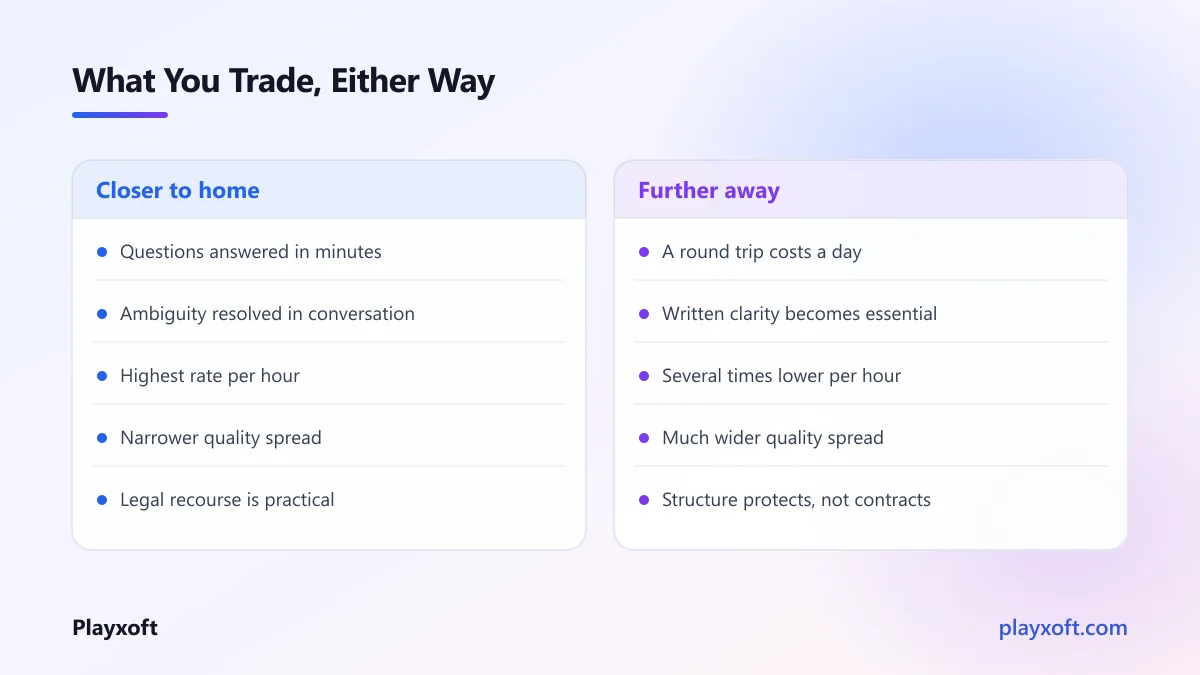
With substantial overlap, the working pattern is conversational. A question gets answered in minutes. A misunderstanding is caught before it becomes a week of work in the wrong direction.
With little overlap, the pattern becomes asynchronous by necessity. You send feedback at the end of your day, it is acted on during your night, and you see the result the next morning. This has a genuine advantage — a round trip happens while you sleep — but it punishes ambiguity severely. A question that could have been resolved in thirty seconds costs a full day.
The practical consequence: with an offshore partner, written clarity stops being a nice-to-have. Vague requirements that an onshore team would resolve by walking over to your desk become a day lost.
The cost difference is real, and it is not the whole picture
Rates vary enormously by region, and offshore rates are genuinely lower — often several times lower than North American or Western European agency pricing for comparable work. For reference, our own blended rate sits at $25 to $45 per hour depending on seniority and stack.
What that number does not capture:
Management overhead. Someone on your side has to specify, review and coordinate. With a distant team and thin overlap, that person spends more time doing it. Budget for their hours, because they are real.
Rework from misunderstanding. Every model has some. Low-overlap arrangements have more, because the feedback loop is slower and errors run further before anyone notices.
Onboarding time. Any external team needs weeks to understand your domain. This cost is identical across models and is routinely left out of comparisons.
A useful way to think about it: offshore reduces your cost per hour substantially, and increases your hours somewhat. For most projects the arithmetic still lands clearly in favour of offshore, but the honest saving is smaller than the rate difference implies.
Where each model genuinely wins
Choose onshore when the work requires constant, unstructured collaboration — early-stage discovery where the product is being invented in the room, or regulated work where physical presence or local legal accountability is required.
Choose nearshore when you want meaningful cost reduction while keeping most of a working day in common, and when your process depends on frequent live conversation rather than written specification.
Choose offshore when you have, or can write, reasonably clear requirements; when the work has a defined shape; when budget matters materially; and when you are willing to invest in written communication. This covers most product builds, most platform work, and most well-understood applications.
Choose a hybrid when you can afford it — a local product owner who owns requirements and decisions, with an offshore team executing. In our experience this is the arrangement that fails least often, across all three models.
Due diligence that actually predicts outcomes
The questions below are worth more than any amount of comparing portfolios, which are curated everywhere.
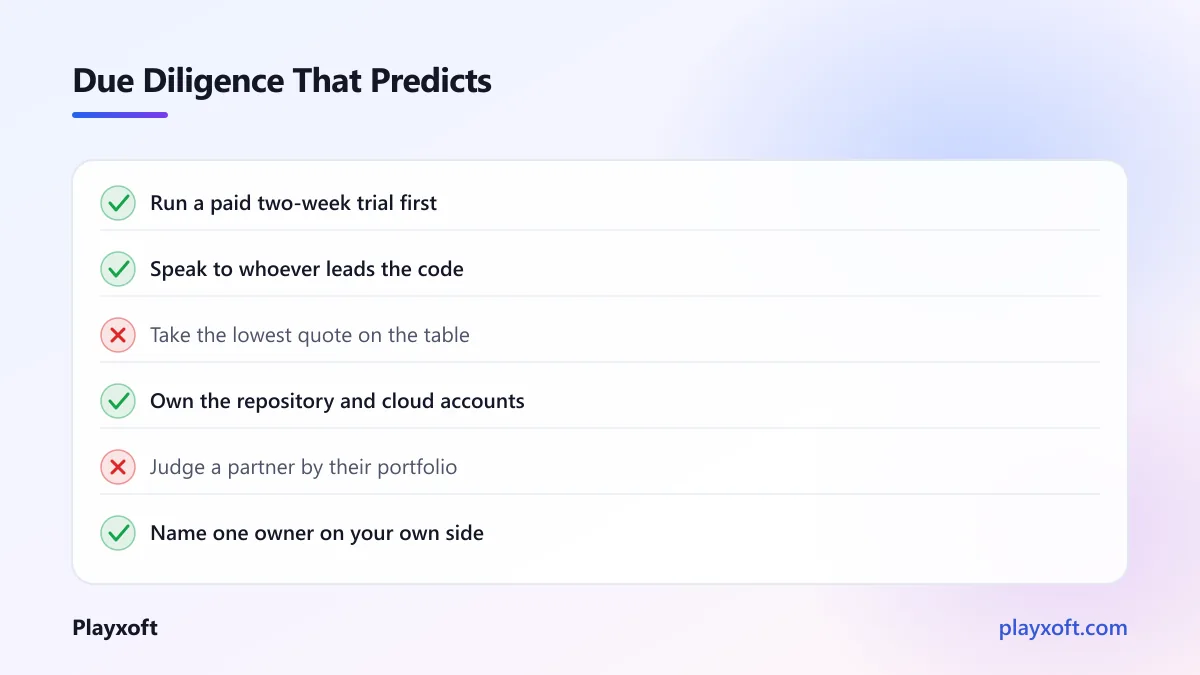
Ask who writes the code, and speak to them. Not the account manager. If you cannot have a technical conversation with the person who will lead the work, before signing, that is a serious signal.
Ask for a paid trial. Two weeks, a real piece of work, at full rate. This is the single most effective piece of due diligence available and remarkably few buyers do it. You learn more in ten days of actual work than in ten meetings.
Check the code ownership terms in writing. Your repository, your accounts, your intellectual property, from day one. Anything else is leverage being built into the arrangement.
Ask about a project that went badly. Willingness to describe one honestly is a strong positive signal, and its absence is a strong negative one.
Verify they exist as a real company. Registered entity, a physical address, a history you can check. This sounds basic; it filters out a genuine share of the market.
If you want an outside read on a proposal
Evaluating technical vendors without being technical is genuinely hard, and most buyers only do it a handful of times in a career.
If you have a proposal in hand — from anyone, including a competitor of ours — we are happy to read it with you and tell you what we would ask before signing. We would rather you hire well than hire us.
Protecting your intellectual property
This is the concern raised most often about offshore arrangements, and it deserves a straight answer rather than reassurance.
The legal position is weaker at distance. Enforcing a contract across borders is slow and expensive enough that, for most small and mid-size companies, it is effectively not a remedy. Anyone who tells you otherwise is selling something.
So rely on structure rather than on recourse:
Own the infrastructure. Your repository, your cloud accounts, your domain registrar, under your credentials. Grant access; do not receive it.
Keep the crown jewels in-house where they exist. If there is genuinely proprietary logic — an algorithm, a model, a dataset — it can sit behind an interface the team integrates with rather than inside the code they hold.
Use written agreements anyway. They matter for professional norms and for the rare case where enforcement is practical, even if you cannot rely on them.
Stage the relationship. Start with something valuable but not existential. Trust is built through delivery, not through clauses. The World Intellectual Property Organization's guidance on IP in outsourcing is a reasonable primer if you want to go deeper.
The warning signs worth walking away from
Across the rescue projects we have taken on, the same signals appear in hindsight:
- The people in the pitch were never seen again after signing
- No written architecture existed, anywhere, at any point
- Code lived in the vendor's repository and was to be "handed over at completion"
- Every status update was a percentage rather than something that ran
- The price was dramatically below every other quote received
That last one deserves emphasis. Very low pricing is not a bargain; it is a signal about who will be assigned and how much time they will be given. There is a real range in this industry, and there is a floor beneath which something is being omitted — usually testing, senior oversight, or both.
Making an offshore software development partner work in practice
If you choose distance, a few habits make the difference between a smooth arrangement and a frustrating one. None of them are expensive; all of them are frequently skipped.
Write things down, and expect the same back. Decisions made in a call should end up in text somewhere both sides can find. With low overlap, memory is not a shared resource.
Use the overlap for conversation, not status. If you have two hours in common, spending them on a status update is a waste — you can read status asynchronously. Use live time for the things that need back-and-forth: ambiguity, disagreement, and decisions.
Insist on seeing working software, frequently. A deployed environment you can open yourself, updated at least every two weeks. This is the single best protection against a project drifting, and it works regardless of distance.
Record the walkthroughs. A ten-minute screen recording explaining what changed is worth more than a written report and costs less to produce. It also survives staff changes on both sides.
Assume good faith about silence. A message unanswered for eight hours usually means the other side is asleep, not ignoring you. Teams that internalise this are far less stressed than teams that do not. Research collected in the DORA State of DevOps reports consistently finds that team communication and psychological safety predict delivery performance more strongly than any technical practice — and that finding holds across distributed teams too.
The thing that actually determines success
Having watched this from both sides, model choice is not the main variable. The main variable is whether one person on your side owns the product, is available to answer questions quickly, and can make decisions without convening a committee.
Projects with that person succeed across all three models. Projects without one struggle in all three, and struggle worst offshore, because the timezone gap turns every unanswered question into a lost day.
If you have that person, an offshore software development partner is a strong and cost-effective choice. If you do not, fix that before choosing a model — it will matter more than anything in this article.
If you are weighing partners and want a conversation that starts with whether the arrangement fits rather than with a rate card, book a free consultation call or email info@playxoft.com. We will tell you honestly if we think a closer team would serve you better.


