What Does It Really Cost to Build a SaaS MVP in 2026? A Founder's Budget Breakdown

A founder comes to a first budget conversation with a tidy feature list, a launch date, and a number they hope is realistic. Then the questions begin. Who uses the product? What happens after they sign in? Does it need billing, an admin area, data imports, or a connection to another system? The list gets longer because the business is becoming real.
That is why a SaaS MVP development cost is not a menu price. It is the cost of making one important promise to a specific customer, reliably enough that they can act on it. Two products can share a feature name such as “dashboard” and require very different work underneath.
Here is the position we take: an early product should be budgeted around the smallest workflow that can change a buyer’s mind. Not around the largest list a team can imagine before it has users. This is not an argument for building something flimsy. It is an argument for putting care, security, and engineering judgment behind the part of the product that earns learning.
A number before a scoping call is a guess
There is nothing wrong with asking for a range early. Founders need a way to decide whether to proceed, raise more capital, or narrow their idea. But a firm quote before a short scoping call is usually a guess dressed up as certainty.
The reason is simple: scope lives in the decisions behind the screens. “User accounts” could mean email sign-in and password resets, or it could include invitations, roles, organisation boundaries, single sign-on, and audit history. “Payments” could mean a basic subscription flow or a set of plans, trials, invoices, upgrades, failed-payment recovery, and regional tax decisions. The Stripe subscription billing overview shows just how many moving pieces can sit behind a familiar billing button.
A useful scoping conversation does not have to be long. It should answer a few hard questions:
- What is the single user outcome the first release must deliver?
- Which users have different permissions or views?
- What information must be created, changed, and retained?
- Which third-party services are truly required at launch?
- What must be safe, observable, and recoverable from day one?
The answers create boundaries. Boundaries are what turn an estimate into a plan that a founder can use.
Why your SaaS MVP development cost changes with scope
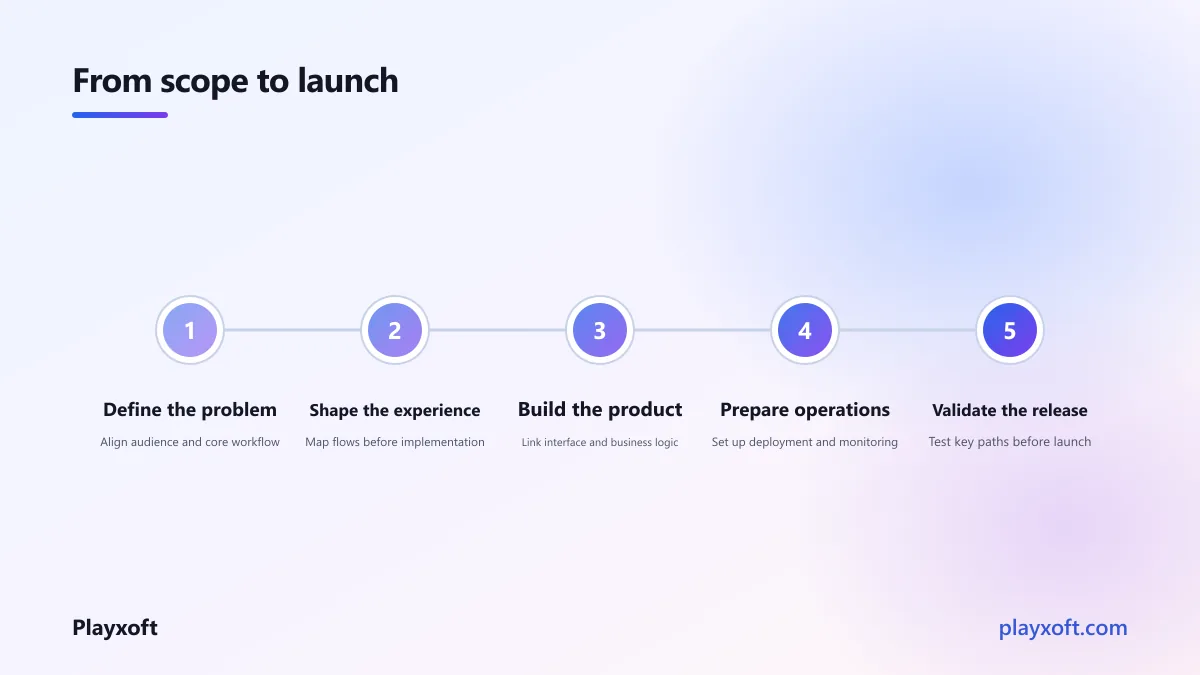
The budget is best understood as a chain of connected choices. Cutting the discovery phase often pushes uncertainty into design and development. Skipping quality assurance can turn a short launch into a long repair cycle. Each line item exists because it removes a different kind of risk.
Discovery and product definition: $1,000 to $3,000
Discovery turns an idea into a buildable first release. It clarifies the customer, maps the core workflow, identifies assumptions, and separates launch-critical work from work that can wait. This is where a team decides whether an integration is essential or merely convenient.
The range moves up when several stakeholders need alignment, the domain is unfamiliar, or existing systems must be understood. It stays lean when a founder has clear customer evidence and can make decisions quickly. The output should be more useful than a pile of notes: a shared scope, priorities, and acceptance criteria.
Product design: $1,500 to $5,000
Good product design is not visual decoration. It is how a team discovers confusing states before writing expensive code. It covers user flows, information hierarchy, interaction details, and a focused visual system.
The cost rises with different roles, unusual workflows, dense data screens, and the need for a reusable component system. A simple MVP can move quickly with a narrow set of screens. A product where users make high-consequence decisions needs more time spent making the next action obvious.
Frontend development: $3,500 to $10,000
Frontend work turns the product flow into an interface that handles real inputs, loading states, errors, and different screen sizes. The visible screen is only the easy part. The effort grows when the application needs complex forms, live updates, data-heavy views, accessibility work, or refined behaviour across many states.
For an MVP, the smart question is not “how many pages?” It is “how many distinct interactions must work without hand-holding?” One carefully designed workflow can cover several pages. Several deceptively simple screens can each hide unique rules.
Backend and integrations: $4,000 to $12,000
Backend work covers the data model, business rules, APIs, permissions, and connections to outside services. It is frequently the largest line item because it carries the truth of the product. If a user changes a record, pays for a plan, or invites a teammate, the system needs to make the right change and protect it.
Cost rises with multi-role access, complex data relationships, migration from another system, real-time events, and deep integrations. It also rises when a product needs a strong audit trail or more demanding security controls. The OWASP Application Security Verification Standard is a useful reference for the sort of security questions that should be made explicit rather than assumed away.
Infrastructure and DevOps setup: $600 to $2,500
Infrastructure is the foundation that lets a product be deployed, configured, monitored, and recovered. This includes environments, hosting, databases, backups, deployment automation, and basic observability.
It grows when a product has special data requirements, several environments, unusual traffic patterns, or strict uptime needs. A lean launch still needs responsible basics. The Google Cloud operational excellence guidance is helpful here: reliable operations are created through deliberate practices, not added after a release is already under pressure.
QA, release readiness, and project management: $1,500 to $4,000 and $1,200 to $4,500
Quality assurance checks that the product works across the paths real people will take, including errors and edge cases. Release readiness covers the handoff from a development environment to a live product. Project management keeps decisions moving, risks visible, and the scope honest.
These are sometimes treated as overhead. They are better viewed as the cost of avoiding expensive ambiguity. The more people, systems, and dependencies involved, the more valuable that coordination becomes.
If you would like a hand turning your feature list into a launchable first scope, talk with the Playxoft team. A focused conversation can reveal what belongs in version one and what is safe to defer.
The three budget bands and what each buys
Budget bands are useful when they describe capability, not just a total. These are Playxoft’s real delivery ranges. They sit well below typical North American and Western European agency pricing because of how our team is structured, not because we skip engineering discipline; a firm number follows a short scoping call.
Lean MVP: $8,000 to $18,000
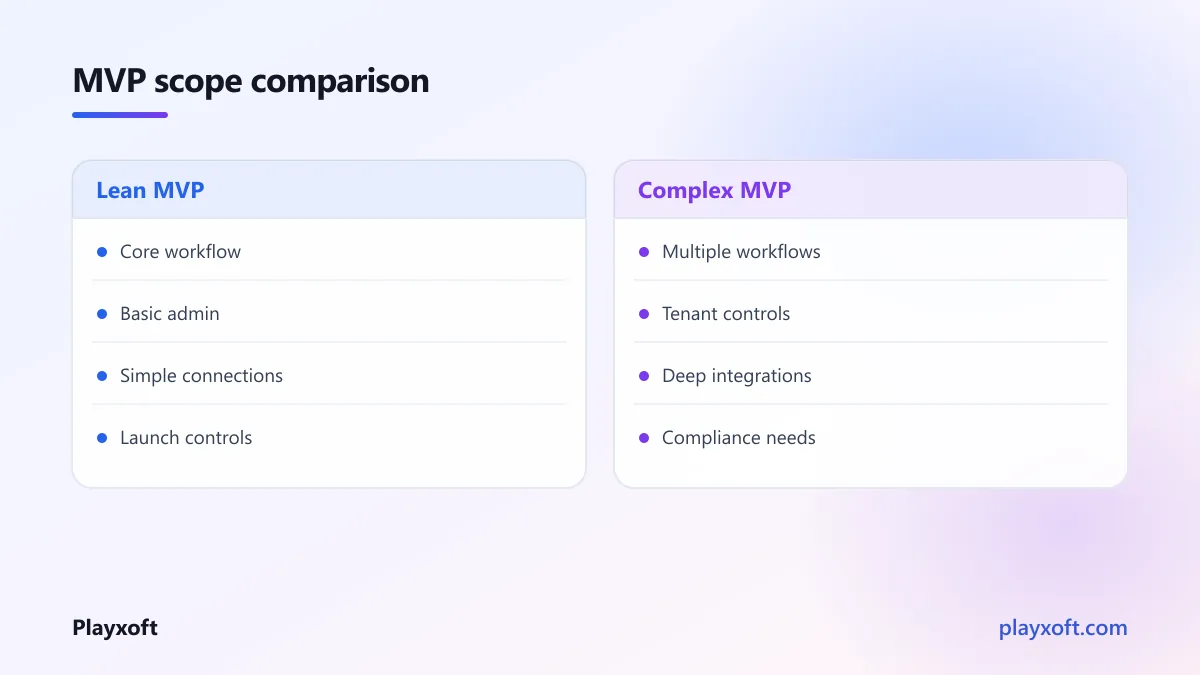
A lean MVP is built around one core workflow. It includes authentication, a basic admin capability, and a launched product that can be placed in front of early users. Think of a narrow tool that helps one type of customer complete one job better than they can today.
What it does not buy is every adjacent workflow. It may not include elaborate reporting, advanced permissions, many integrations, or a large catalogue of edge cases. That focus is its value. The buyer gets a usable product and a faster route to evidence, provided the team protects the boundary.
Standard MVP: $18,000 to $40,000
A standard MVP supports a more complete business motion: multiple user roles, billing, integrations, and analytics. This is often the right band when the first customers need collaborators, when revenue collection must be part of the experience, or when the product must fit into an existing operational habit.
The buyer gets a product that can support a more credible pilot and a clearer commercial conversation. The risk is adding “standard” features without a standard for why they matter. Every addition should still trace back to activation, retention, or a necessary operational constraint.
Complex MVP: $40,000 to $85,000
A complex MVP can include a multi-tenant platform, heavy integrations, and compliance needs. It is appropriate when the core value depends on systems talking to each other, on organisations managing their own people and data, or on requirements that cannot responsibly be postponed.
The buyer gets more product surface and stronger foundations for a demanding market. They also take on a larger coordination burden. A complex product needs an even sharper definition of what must be proven at launch, because complexity without a validated thesis is merely expensive.
What moves the estimate up or down
The price bands are not a feature checklist. The same total can fund very different outcomes depending on the decisions around it.
Costs tend to rise when the product has several user types, needs deep connections to external systems, stores sensitive information, or must behave in real time. They also rise when feedback is slow. A team waiting days for product decisions will spend more time revisiting work than a team with a clear founder available to resolve trade-offs.
Costs tend to stay lower when the first release serves a narrow customer, uses proven services for commodity needs, and commits to a single measurable workflow. Reusing familiar patterns is not a lack of ambition. It reserves custom engineering for the part of the experience that makes the product worth choosing.
There is another lever founders often miss: sequencing. A useful roadmap labels features as now, next, and later. “Later” is not a graveyard. It is a promise to make a decision with user evidence instead of imagination. That sequencing keeps the MVP honest while preserving the product vision.
How to make a scoping call worth the time
Arrive with the customer problem, the user who feels it most, and the action that proves the product helped. Bring sketches if you have them, but do not wait for polished mock-ups. A frank conversation about uncertainty is more valuable than a detailed document full of untested assumptions.
Ask the development partner to explain the trade-offs, not only the total. Which workflow creates the most learning? Which integration can be deferred? Where would a simpler design reduce risk? Which requirement makes the architecture materially different? The quality of those answers tells you more than a quick estimate ever can.
You should leave with a shared release boundary, a view of the major risks, and a route from the first version to the next. That is what makes a budget a strategic tool rather than a procurement hurdle.
The SaaS MVP development cost decision that matters
What a SaaS MVP really costs is shaped less by the number of screens than by the decisions a product must make correctly for its first users. Fund the learning loop, protect the essential workflow, and make every extra capability earn its place.
If you are ready to turn an idea into a focused product plan, book a free consultation call with Playxoft or write to info@playxoft.com. We will help you define a SaaS MVP development cost that supports a confident launch, not a wishful estimate.


