The Real Cost of Technical Debt: How to Spot It Before It Costs You Customers


The warning rarely arrives as a dramatic outage. It arrives as a small promise that moves to next week. A customer asks for a reasonable change, the team says it should be simple, and then someone discovers three systems that all need to move together. The release slips. Support has another awkward conversation. A competitor gets a little more room to look responsive.
That is the cost of technical debt. It is not merely an engineering concern or a messy codebase that irritates developers. It is a business drag that makes a company slower at the exact moment it needs to learn, respond, and earn trust.
Leaders often see the expense only when a rewrite is proposed. By then, the signals have usually been visible for months: releases feel tense, known defects stay open, new engineers take too long to contribute, and customers start hearing “not yet” too often. The more useful question is not whether your product has debt. Every product does. The question is whether you can see its interest payments before customers feel them.
The cost of technical debt is paid in lost options
Technical debt is a useful metaphor because it describes a trade-off. You borrow time today by taking a shortcut, then accept a future obligation to make that shortcut safe, clear, or scalable. Martin Fowler's explanation of the metaphor makes an essential distinction: some debt is deliberate, while some is reckless.
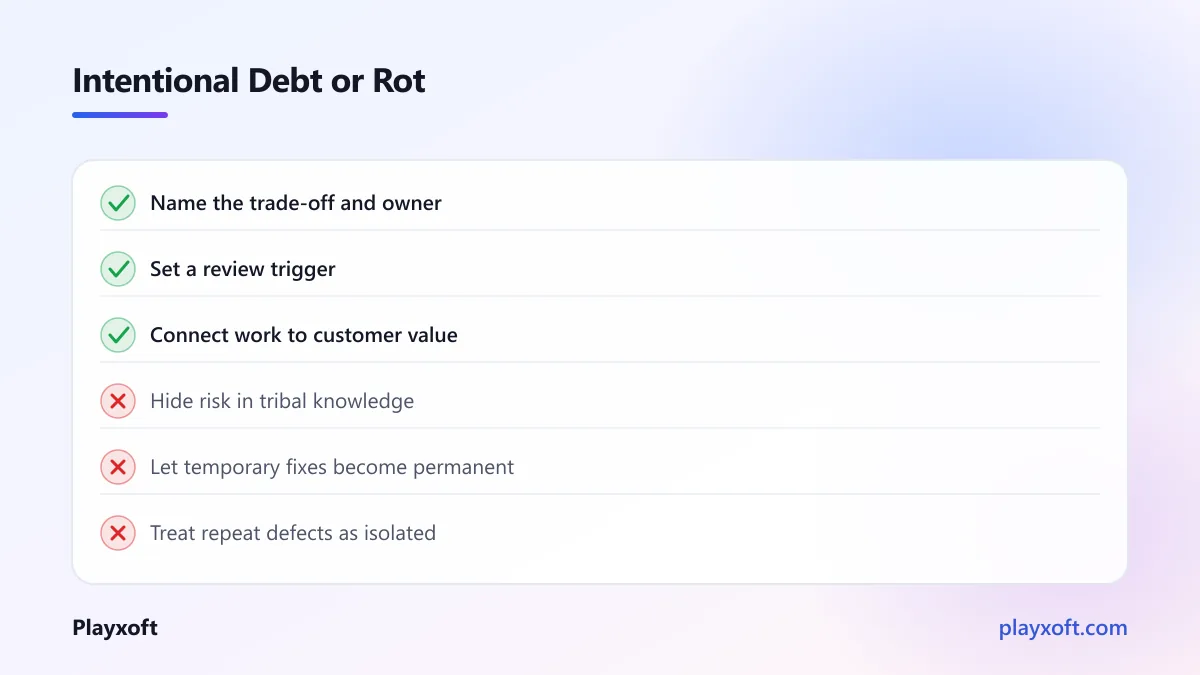
Deliberate debt is a business decision. A team might build a narrow internal workflow to test demand, defer a less-used integration, or use a manual process while it learns what customers actually need. The trade-off is named, bounded, and revisited. There is an owner, a reason, and a moment when the team will decide whether to repay it.
Accidental rot is different. It grows when nobody can explain why a component works the way it does, tests no longer give credible feedback, ownership is vague, and each urgent fix adds another exception. It is not an intentional loan. It is a compounding blind spot.
The business cost is not limited to engineering hours. It narrows your options:
- A promising customer request becomes risky to accept.
- A market shift becomes harder to answer before the window closes.
- A defect takes longer to diagnose because the system has no clear boundaries.
- A new hire spends weeks decoding history instead of improving the product.
- A team begins choosing what is easy to change over what matters most to customers.
That last point deserves attention. When the architecture quietly dictates the roadmap, product strategy has already lost some of its freedom.
Four ways debt reaches the customer
Releases slow down before anyone calls it a problem
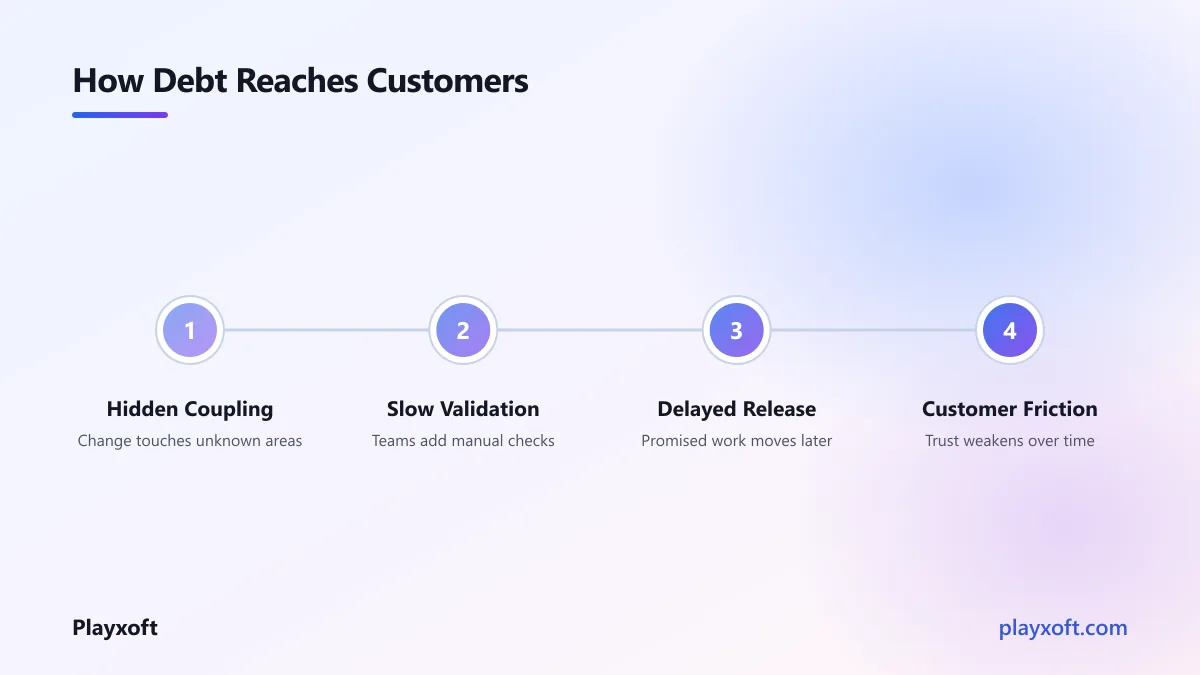
An early product can move quickly with a few people holding most of the context in their heads. Growth changes the math. More integrations, more user roles, more data, and more people touching the code create coordination costs. If every release needs heroic checking, an informal freeze, or a handful of people who must be online, the delivery system is sending a message.
The issue is not that careful releases are bad. The issue is when caution is compensating for uncertainty. A team cannot confidently predict what a change will affect, so it substitutes meetings, manual testing, and late-night vigilance for a dependable path to production.
Customers experience that uncertainty as delayed improvements. They do not need to know the word “dependency” to notice that a promised capability keeps moving.
Bug counts become a trust tax
One isolated defect is normal. A pattern of regressions is more revealing. When a fix in billing breaks reporting, or a new permission rule changes what another role can see, the product is telling you that its parts are too tightly coupled or too poorly understood.
This is why a raw count of open bugs is not enough. Look at their shape. Are the same areas generating repeat incidents? Are support tickets clustered around recent releases? Do temporary fixes remain in place because touching the underlying code feels dangerous? Do engineers avoid a module even when it blocks valuable work?
Good reliability work makes these conversations factual. Google's SRE guidance on monitoring is useful here because it frames monitoring around signals that matter to users, not just whether a server is running. Pair product and support signals with engineering signals. A deployment can succeed technically while still causing customers friction.
Onboarding time reveals hidden complexity
The fastest way to expose accidental rot is to ask a capable new developer to make a modest change. Can they find the relevant code? Can they run the system locally? Can they tell whether their change is safe? Can they get a useful review from someone who understands the area?
If the answer depends on a long-tenured engineer narrating tribal knowledge, you have a capacity constraint disguised as experience. That person may be excellent. The system is still fragile if it only works through them.
Slow onboarding matters commercially because it delays the moment when new capacity becomes real capacity. It also concentrates risk. When a few people become the interpreters of every important system, roadmap speed depends on their calendar, their availability, and their ability to hold a growing history in memory.
Churn often starts with a broken expectation
Customers do not usually leave because they have formed an opinion about your internal architecture. They leave when the service feels unreliable, when a feature gap stays open too long, or when they must repeat the same issue to support. Technical debt is often the hidden connection between those moments.
That connection is especially serious in a subscription product. Retention is built through many small confirmations that the product works, improves, and listens. Debt interrupts all three. It turns feedback into backlog debate, maintenance into a release risk, and a routine incident into a relationship test.
If you'd like a hand turning those vague warning signs into a clear engineering and product plan, talk with Playxoft. A focused outside review can help separate the debt that protects learning from the rot that is draining momentum.
Do not treat all debt as a failure
The strongest teams do not pursue a perfectly pristine codebase. That goal is expensive, often unhelpful, and can become a way to avoid shipping. They make debt visible and make its purpose explicit.
Deliberate debt has a decision record. It answers a few plain questions:
- What are we choosing not to build or clean up now?
- What customer or business learning does that choice buy us?
- What could fail or slow down because of it?
- Who will decide when it needs attention?
- What signal will trigger that decision?
For example, a startup may intentionally keep an approval process manual while it learns what different customer segments need. That can be sensible. The dangerous version is leaving the manual path scattered through the application until nobody knows where policy ends and code begins.
Accidental rot has no such story. It is marked by ambiguous ownership, duplicate business rules, unexplained scripts, fragile deployments, and fixes that create more exceptions. It is also often born from success: a product finds demand faster than its early structure can support. There is no shame in that. There is only a choice about whether to manage the transition deliberately.
Run this technical debt self-assessment this week
You do not need a six-month audit to get an honest first picture. Gather a product leader, an engineering lead, someone close to support, and one developer who regularly ships changes. Give the conversation an hour. The goal is not to produce a score that looks scientific. It is to find the few places where debt is already changing customer outcomes.
Start with the last few releases
Choose recent releases that mattered to customers. For each one, ask:
- What made the work take longer than expected?
- Which parts required manual checking or special coordination?
- What changed after release that the team did not expect?
- Did a customer-facing issue create follow-up work for support or sales?
Listen for repeated module names, recurring handoffs, and phrases such as “we always have to be careful there.” Those are not complaints to dismiss. They are a map of where delivery confidence is thin.
Follow a support issue to its root
Pick a recent customer problem that took too long to resolve. Trace it backwards: what did the customer see, what did support need to explain, what information was missing, and what engineering change was required?
This exercise moves the discussion away from abstract code quality. It shows the path from a technical limitation to a real customer interaction. It can also uncover gaps in observability, documentation, and ownership that a code review alone will miss. The NIST Secure Software Development Framework offers a helpful reminder that secure, maintainable delivery relies on repeatable practices across the development lifecycle, not a final inspection at the end.
Test the newcomer path
Ask a developer who has not worked in the area to trace a customer-facing workflow and propose one small change. Watch for friction: setup that fails, unclear local data, tests that cannot be trusted, or a review process that cannot explain the intended behaviour.
You are not testing the developer. You are testing whether your organisation can transfer knowledge without a guided tour. A product that only moves quickly through institutional memory is carrying more debt than its backlog reveals.
Turn findings into a business decision
Finish by listing the three issues that most affect one of these outcomes: release speed, customer trust, team capacity, or operating risk. For each issue, write the next decision rather than a vague intention. That might be to assign an owner, add a boundary around a fragile component, automate a release check, document a critical workflow, or schedule a contained refactor alongside an upcoming feature.
Keep the work connected to a product milestone. A debt item with no customer or delivery context is easy to postpone forever. A debt item attached to a renewal risk, a planned integration, or a hiring goal is easier to prioritise honestly.
Make repayment part of how you scale
Technical debt becomes expensive when it is treated as an occasional cleanup project. A better model is continuous portfolio management. Every quarter, review the shortcuts you knowingly accepted, the areas generating recurring friction, and the systems that now carry more business importance than they did when they were first built.
That review should include product leaders, not only engineers. Engineering can explain the mechanism. Product and commercial leaders can explain the cost of waiting. Together, they can decide whether a shortcut still buys speed or now blocks it.
There is a practical leadership test here: can your team explain its trade-offs in plain business language? “This component has low test confidence” is useful, but “this component makes customer-specific changes unpredictable” gives a decision-maker something to act on. The most effective technical leaders translate both ways without diluting the truth.
The Cost of Technical Debt is ultimately the cost of lost confidence: confidence that a release will work, that a new colleague can contribute, that a customer request is feasible, and that the company can act when the market moves. Teams that see it early do not need to chase perfection. They protect their ability to choose.
If release friction, recurring defects, or slow onboarding are already limiting your next move, book a free consultation call through the Playxoft contact page or email nitheesh@playxoft.com. We can help you turn hidden technical debt into a focused plan for faster delivery and stronger customer trust.


