Unity vs Unreal for Mobile Games: A Studio's Honest Take

Every few months someone asks us to settle this, usually in the tone of a person hoping we will just say a name so they can stop thinking about it.
We ship mobile games in Unity. That is a real bias and you should weigh it. But the honest answer to Unity vs Unreal for mobile is that the engine is rarely the thing that decides whether your game succeeds, and the teams who agonise over it are usually avoiding a harder question about scope.
That said, the choice does matter at the margins, and on mobile those margins are tighter than on any other platform. Here is how we actually think about it.
Unity vs Unreal on mobile: the short version
If you want the answer before the reasoning: for most mobile projects, Unity. Not because it is the better engine in the abstract — on raw rendering capability it is not — but because mobile rewards small builds, fast iteration and easy hiring, and Unity is stronger on all three.
Unreal earns its place when visual fidelity is the product, when your team already knows it, or when you are bringing an existing Unreal title to phones.
Everything below is why, and where that guidance breaks down.
Mobile is a constraints problem, not a graphics problem
On PC and console, engine comparisons are mostly about rendering features. On a phone, you are fighting four things that have nothing to do with how pretty your shaders are:
Download size. Every extra megabyte costs installs. Users on mobile data hesitate at large downloads, and both stores flag size limits that affect who can install over a cellular connection at all.
Thermals. A phone that gets hot throttles its own processor. A game that looks glorious for four minutes and then runs at half speed is a worse game than one that looked merely good the whole time.
Battery. Nobody uninstalls a game for draining their battery. They just stop opening it, which is worse, because you never find out why.
Device spread. Your audience is not holding the phone you tested on. A meaningful share of players worldwide are on mid-range Android hardware that is three or four years old.
Judge the engines against those four, not against a feature checklist.
Build size: Unity starts smaller
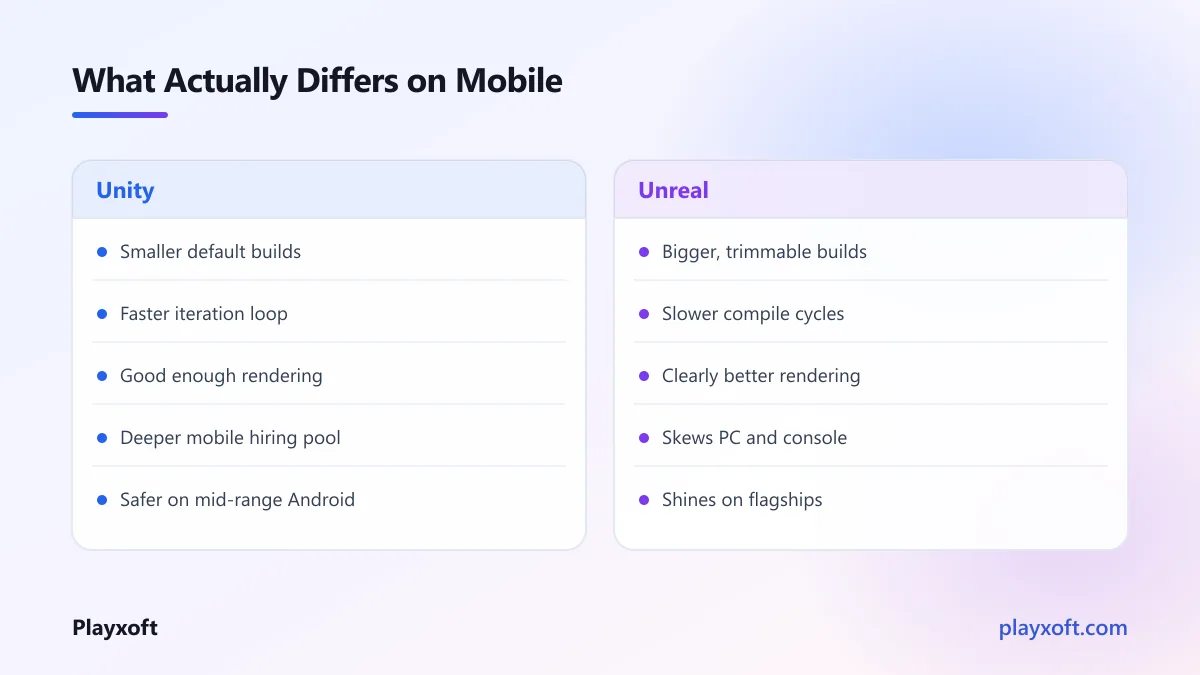
An empty Unity project produces a smaller binary than an empty Unreal one, and that gap is real enough to matter for a casual or hyper-casual title where install conversion is the whole business.
Both engines can be trimmed hard. Unreal ships tooling to strip unused content and shader permutations, and a disciplined team can get a shipping Unreal mobile game to a reasonable size. But "can be trimmed hard by a disciplined team" is doing a lot of work in that sentence. Unity's default position is closer to where mobile wants to be, and defaults matter when you are shipping on a deadline.
If your game is a puzzle, a card game, a casual arcade title, or anything where you expect people to install on a whim, this point alone is close to decisive.
Rendering: Unreal is better, and it may not matter
Unreal's renderer is genuinely ahead, and on high-end phones you can see it. If your game's pitch is visual spectacle — a 3D action title where fidelity is the reason someone downloads it — Unreal gives you more out of the box.
The catch is that the phones which show off that advantage are a minority of your installs. Designing for the top of the market means either shipping a game that runs badly for most players, or building two quality tiers and maintaining both.
We have watched teams choose Unreal for visual ambition and then spend the back half of the project taking features out to hit frame rate on mid-range hardware. That is not an engine failure. It is a scoping failure that the engine choice enabled.
Iteration speed: this is the one nobody weighs enough
Here is the metric we care about most, and it rarely appears in comparison articles: how many times per day can a designer change something and see the result?
A game is not designed on a whiteboard. It is found, through hundreds of small adjustments to feel, timing and feedback. The engine that lets you make more of those adjustments per week produces a better game, almost regardless of its rendering ceiling.
Unity's iteration loop on mobile is faster for most teams — quicker entry into play mode, faster script compilation, and a smaller mental gap between editing and testing. Unreal's Blueprint system is excellent for designers and genuinely narrows the gap, but C++ compile times on a large project are a real tax, and shader compilation can stall you at the worst moments.
If your team is small and your game lives or dies on feel, weight this heavily.
Hiring: the pool is not the same size
This is a business constraint that engineers tend to dismiss and studio owners cannot afford to.
There are substantially more mobile-experienced Unity developers available worldwide than mobile-experienced Unreal developers. Unreal talent skews toward PC and console, because that is where the engine has dominated. If you need to add two people in a hurry, or replace someone mid-project, the Unity pool is easier and usually cheaper to hire from.
This also affects your future. A game you cannot staff is a game you cannot maintain, and mobile games need maintenance for years after launch.
If you are still genuinely torn
In our experience, teams that cannot decide are usually not stuck on the engine — they are stuck on scope. The engine question gets easy the moment you can state, in one sentence, what the player does in the first thirty seconds and why they come back on day three.
If you would like a second opinion on that before you commit a year to it, we are glad to talk it through. We would rather help you scope the game properly than sell you an engine preference.
Licensing: read the current terms yourself
Both engines have changed their commercial terms in recent years, and both have moved in ways that surprised developers who had planned around the old arrangements.
We are deliberately not quoting specific percentages or thresholds here, because they change and a blog post is the wrong place to learn them. Go to Unity's licensing page and Epic's Unreal Engine licensing terms and read what applies today, at your revenue level, in your region.
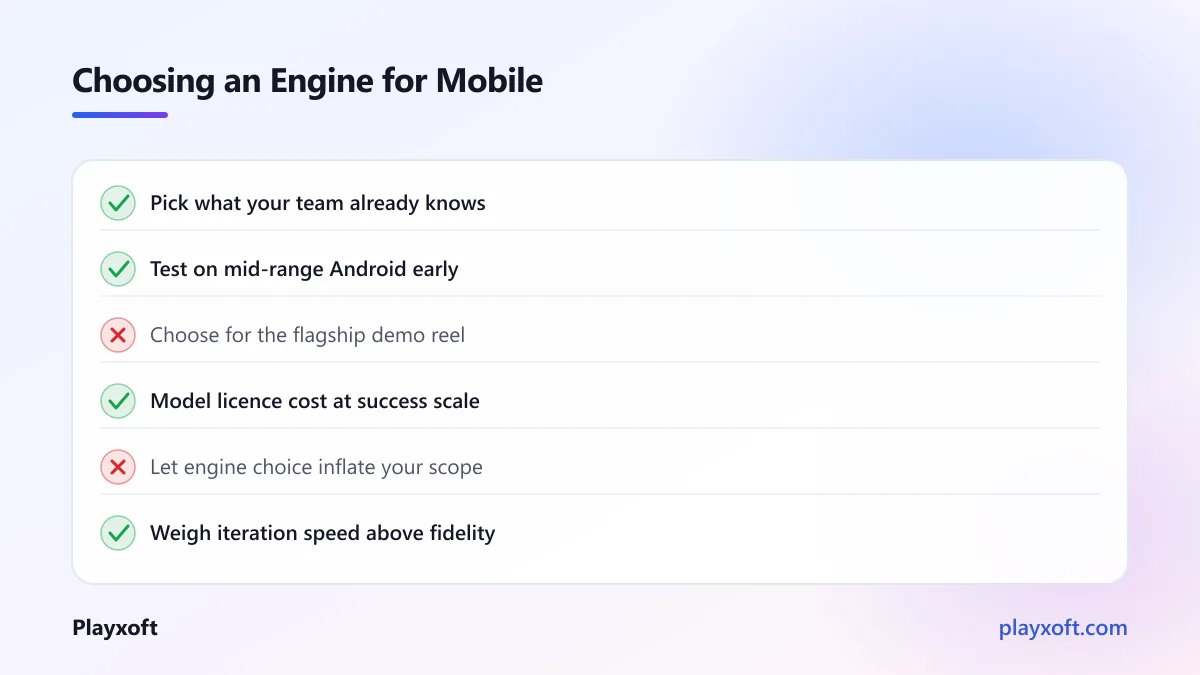
The practical advice: whichever you pick, model the cost at a success scenario, not just at launch. An engine cost that is trivial at ten thousand players can be meaningful at a million.
Our actual recommendation, by project type
Stripping out the diplomacy:
Casual, puzzle, card, hyper-casual, or anything free-to-play at volume. Unity. Smaller builds, faster iteration, easier hiring, and the rendering advantage is irrelevant to your genre.
Real-time multiplayer mobile at mid fidelity. Unity. The tooling around networking and live operations on mobile is well-trodden, and iteration speed matters more than pixels.
A visually ambitious 3D title aimed at flagship devices, with an experienced team. Unreal, if and only if you have people who have shipped mobile in it before. The engine will not save an inexperienced team from mobile's constraints.
Porting an existing PC or console Unreal title to mobile. Unreal, obviously. Rewriting in another engine is almost never worth it.
You already have a team fluent in one of them. Use that one. Team fluency beats every argument above, comfortably. A team's second month in a familiar engine is worth more than its first six in a better one.
What happens after launch matters more than launch
Engine comparisons almost always stop at shipping day, which is strange, because a mobile game earns most of its money afterwards.
Three post-launch realities should influence the choice:
You will be pushing content updates for years. Every update is another build, another store review, another round of testing across devices. An engine with a slower build and iteration cycle taxes you every single time, forever. That compounding cost is invisible on day one and very visible in year two.
You will need to support devices you have never seen. Crash reports arrive from hardware nobody on the team owns. The size and maturity of the community around your engine directly affects how quickly you find out that a specific chipset has a specific driver bug.
Live operations need tooling. Events, offers, remote configuration, A/B tests and analytics all need to be wired in and then maintained. Both engines support this well, but the mobile-specific tooling ecosystem around Unity is broader, simply because more mobile games have been shipped in it.
None of this is decisive on its own. It is the kind of thing that makes a team's third year pleasant or exhausting, and it is worth ten minutes of thought before you commit.
The engine is the least interesting decision you will make
We have shipped games that did well and games that did not, and the engine was never the reason either way. Scope, feel, the first-session experience, and whether anyone finds the game — those decided it.
Pick the engine that lets your specific team iterate fastest on the specific game you are making, then stop thinking about it and go make the game. The Unity vs Unreal debate for mobile has consumed more studio hours than it has ever saved.
If you are weighing an engine because you are about to start a mobile game and want a studio that has shipped them before, book a free consultation call or email info@playxoft.com. We will give you a straight answer about scope, cost and timeline — including telling you if we think the idea needs to get smaller before it gets built.



