7 Reasons SaaS MVPs Fail in the First Year - And How to Fix Each One


A founder we know shipped a genuinely good product. Clean interface, solved a real problem, no serious bugs. Eleven months later he shut it down.
When we asked what went wrong, he said something we have heard almost word for word several times since: "I thought the hard part was building it."
That sentence is most of the answer to why SaaS MVPs fail. The building is the part with a clear finish line, so it absorbs all the attention, and everything else gets treated as something to figure out afterwards. Then afterwards arrives and there is no runway left to figure anything out.
Here are the seven failure modes we see most often, and what actually fixes each.
1. It was built for a user who does not exist
The most common failure, and the hardest to see from inside.
Somewhere early on, a composite person forms in the founder's head: a small business owner who is frustrated with spreadsheets, technically comfortable, and actively looking for a better tool. Every feature decision gets validated against this person. The problem is that they were assembled from assumptions rather than observed in the world.
Real users are more specific and more awkward. They have an existing process that half-works. They are not looking for a tool. They will not adopt something that requires them to change how their team already operates, no matter how much better it is.
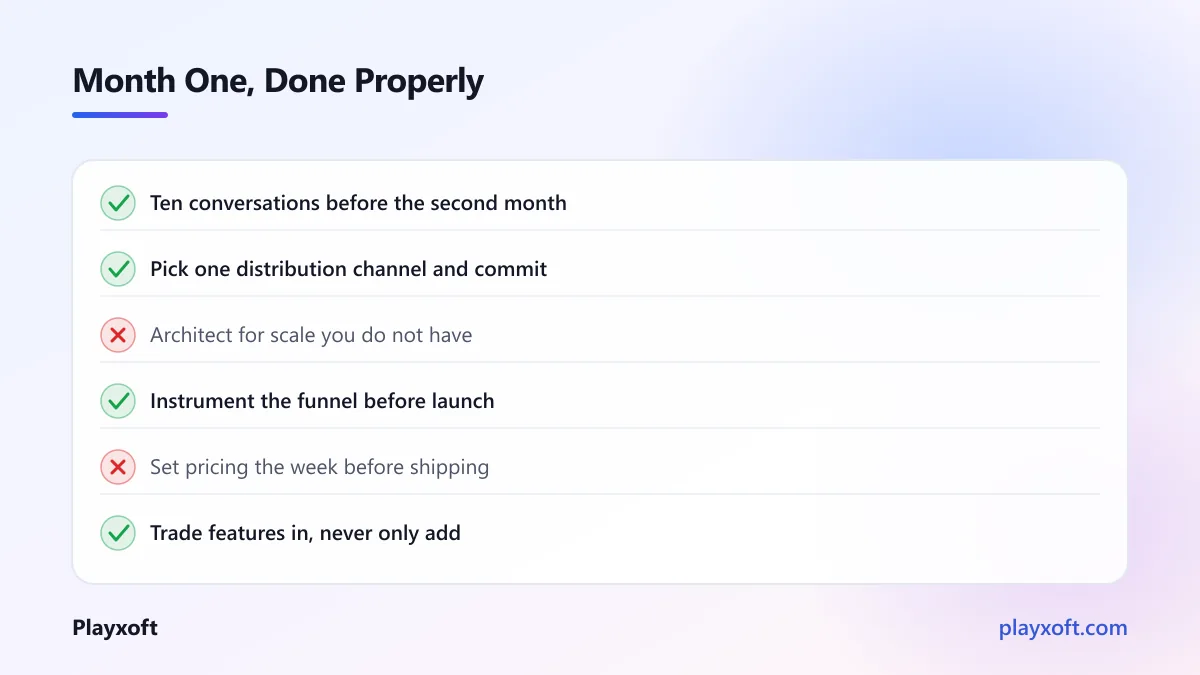
The fix: before you write the second month of code, have ten real conversations with people who currently have the problem. Not about your product — about their week. What do they do now, what does it cost them, what have they already tried and abandoned. If you cannot find ten such people, that is itself the most useful finding you will get all year.
2. There was no plan for how anyone would find it
Founders routinely spend six months on the product and six days on distribution, then are surprised that launching produces silence.
Building is a solvable engineering problem with a known process. Distribution is neither, and it is harder. "We will post on social media and do some content marketing" is not a plan; it is a description of activities.
The fix: decide your first channel before you build, and make it specific enough to act on. Not "content" but "we will answer the twenty questions our buyers search for, and rank for them." Not "partnerships" but "these six companies already serve our customer and do not compete with us." Then check that the channel you picked can plausibly reach enough people to matter.
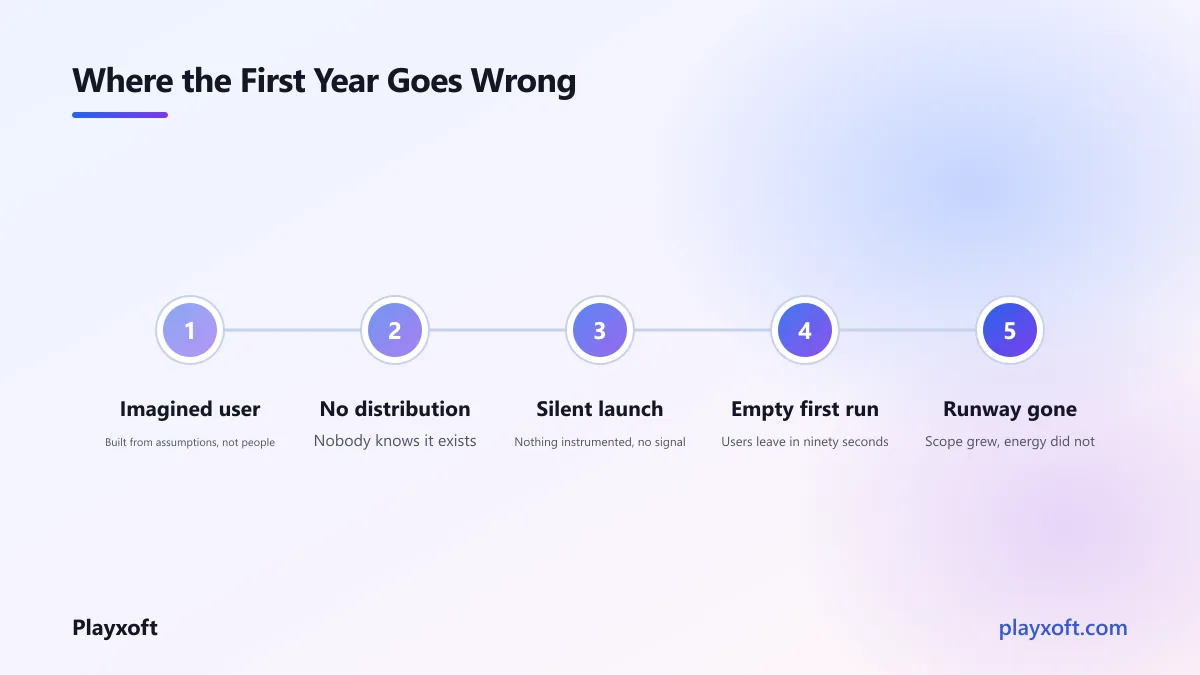
3. It was over-engineered for a scale that never came
A team builds for a hundred thousand users while having none. Multi-region deployment, elaborate microservices, a caching layer for traffic that does not exist, an abstraction layer in case the database changes.
Every one of those decisions is defensible in isolation. Together they turn a three-month build into a nine-month one and make each subsequent change slower, which is exactly the wrong trade when you still do not know what to build.
The fix: build for the next ten times your current scale, not the next thousand. A single well-structured application on a managed database serves far more traffic than most people assume. Martin Fowler's writing on the monolith-first approach makes the case well: you cannot draw good service boundaries before you understand the domain, and you do not understand the domain yet.
4. Nobody instrumented anything
Three months after launch, the founder can tell you how many people signed up. They cannot tell you how many completed onboarding, which step lost the rest, what the people who stayed did differently in week one, or which feature the paying customers actually use.
Without that, every product decision is a guess, and you have a limited number of guesses before the money runs out.
The fix: instrument the funnel before launch, not after. It is a day of work. You need, at minimum: signup, onboarding completion, first meaningful action, return visit in week one, and whatever your core repeated action is. Five events. That is enough to find out where people fall out.
5. Onboarding was treated as a detail
This is the one that quietly kills otherwise good products.
The founder knows the product intimately, so the first-run experience seems obvious to them. To a new user it is an empty screen with no data, no context, and no obvious first move. They poke at it for ninety seconds and leave, and they never come back, and nothing in your analytics tells you they were a genuinely good fit.
The fix: treat the first five minutes as the most important feature you have. Get the user to one real moment of value before asking them to configure anything. Pre-populate sample data. Reduce the setup to the single field you truly cannot proceed without. Watch five people use it for the first time without helping them, which is uncomfortable and more informative than a month of analytics.
If you are reading this mid-build
If several of these feel close to home, that is normal and it is recoverable. Most of these failures are fixed by changing what you work on next, not by rewriting what you already have.
If you would like an outside read on which of the seven is actually your constraint, we are happy to spend half an hour on it with you. Often it is not the one the team is worried about.
6. The pricing was decided last and guessed
Pricing tends to get set the week before launch, by comparing against two competitors and picking a number slightly below.
That produces two predictable problems. Priced too low, you attract customers who churn fastest and generate the most support, and you cannot afford to serve them. Priced too high with no clear value story, nobody converts and you conclude the product is wrong when the packaging was.
The fix: ask about money during your customer conversations, before the product exists. What do they currently spend solving this, in tools and in hours? What would they have to see to justify a budget line? Price against the value of the problem, not against a competitor's page. And treat your first pricing as a hypothesis you will revise, not a permanent decision.
7. The founder burned out on a scope that kept growing
The least discussed and among the most common.
Scope creep on an MVP is rarely dramatic. It is one more feature because a prospect mentioned it, one more integration because it seemed small, one more redesign because the first one felt dated. Each is individually reasonable. Together they push launch out by months, and the energy that was supposed to carry the product through its first year gets spent before launch day.
The fix: write down your launch scope and date, then treat additions as trades rather than additions. Something new goes in only when something else comes out. Keep a visible list of what you deferred — it makes cutting feel like sequencing rather than losing, which is the difference between a team that can say no and one that cannot.
Why SaaS MVPs fail: the pattern underneath all seven
Read them together and the same shape appears: each failure comes from spending effort on the part of the problem that feels tractable instead of the part that is decisive.
This is not a new observation. Steve Blank's argument that startups should search for a business model rather than execute one is two decades old and still routinely ignored, because executing feels productive and searching feels like drifting.
Building is tractable. Talking to strangers about their problems is not. Architecture is tractable. Choosing a distribution channel and sticking with it for six months is not. Adding a feature is tractable. Cutting one is not.
The teams that make it past the first year are not the ones who build best. They are the ones who spend their attention on the uncomfortable half of the work early, while there is still runway to act on what they learn.
What we would do in month one
If we were starting a SaaS product today, month one would contain almost no code:
- Ten conversations with people who have the problem now
- One written page describing exactly who it is for and what it replaces
- A chosen first distribution channel, with a reason
- A launch scope small enough to build in eight to twelve weeks
- A pricing hypothesis based on what the problem costs them today
Then build. With those five things settled, the build is the easy part — which is the opposite of how it feels when you are standing at the start.
None of this guarantees anything. Plenty of well-researched products still fail, because the market moved or the timing was wrong or a better-funded competitor arrived. But the seven reasons SaaS MVPs fail that we have listed here are the avoidable ones, and avoidable failures are the only kind worth spending effort on. Getting past them does not make you successful. It makes you still in the game a year later, with real users and real information, which is the only position from which success is available at all.
If you are heading into a first build and want a partner who will push back on scope before writing code, book a free consultation call or email info@playxoft.com. We would rather talk you out of building the wrong thing than invoice you for it.


